Who Owns the Guest? Airbnb, AI Search and the Wall Around Hosts

Airbnb's new house rules were presented as a courtesy to guests. Read beside the ban on collecting a guest's email, phone number or ID, and beside the chief executive's admission that Airbnb "doesn't work very well" inside AI agents, they look like something older and more familiar: a gatekeeper tightening its hold on supply while the front door moves.
Key facts
- On October 20, 2026, Airbnb told hosts that for reservations booked from November 20 they may not ask guests to wash dishes, strip beds or carry trash off-site, and may not impose fines.
- A second policy published the same day bars hosts from soliciting a guest's phone number, email address or identification "at any point during the booking process or stay," and from keeping a copy of an ID shown at check-in.
- On October 1, 2026, Brian Chesky told TechCrunch he had used Airbnb inside the consumer AI agents Muse and Instinct, and that "it doesn't work very well."
- US newspaper classified revenue peaked at $19.6 billion in 2000 and stood at $4.6 billion in 2012, the last year the Newspaper Association of America reported it.
- TripAdvisor shares closed down 22.4 percent on November 7, 2019, after the company named Google's own hotel results its "most significant challenge."
- Booking Holdings spent $8.2 billion on marketing in 2025, 30 percent of revenue, "primarily" on search engines, "primarily Google."
- New questions on Stack Overflow fell from more than 200,000 a month at the March 2014 peak to under 4,000 in December 2025.
The headline, and the part beneath it
The announcement that traveled was the chores. On October 20 Airbnb emailed hosts a notice titled "Important changes to house rules," and within two days Skift, CNN and the Associated Press had the story. From November 20, a host may not ask a guest to wash the dishes, strip the beds or take the garbage to an off-site bin. Fines are gone. House rules shrink to seven standard fields, and whatever does not fit becomes a "request" that guests are encouraged, though not obliged, to honor.1, 2
What got less attention sat in a second policy posted the same day. "With limited exceptions," it reads, "hosts may not solicit personal data at any point during the booking process or stay." The list begins with contact information, "such as their phone number, home address, or email address," and runs through "identification details or documents such as a guest's passport, driver's license, social security number, or photo." A host may still glance at an ID at the door, provided the listing says so. Keeping a copy is prohibited.3 In parts of the United States and Canada, meanwhile, the phone number a host sees is already a temporary one, assigned at booking and retired two days after checkout.4 The exceptions and the pre-November checklist are in our note on the November 20 rules.
Put the two policies side by side and the guest arrives, stays and leaves without a trace the host is permitted to keep. The booking belongs to Airbnb. The cleaning belongs to the host. The relationship belongs to no one in particular, which in practice means the platform.
It is an odd thing for a marketplace to do at the top of its scale, unless something has changed about where guests come from.
Why now: the door is moving
Something has. Travel searches are beginning in AI assistants, and the companies whose business depends on being the starting point have noticed. Booking Holdings now warns investors that the platforms it relies on for traffic "increasingly incorporate Gen AI features, such as AI-generated answers, assistants, and recommendations, that may satisfy user intent without directing users to our services."5 Booking.com and Expedia both opened apps inside ChatGPT in October 2025. Airbnb did not.6
Chesky has been candid about the reasons. Interviewed by TechCrunch on October 1, 2026, he described trying his own product inside two consumer AI agents: "I've used Airbnb on Muse and Instinct. And it doesn't work very well. I mean, even hotels don't work that well, but Airbnbs work even worse. So I don't think we've cracked consumer AI."7 On the first-quarter earnings call in May he had already told analysts that "the design of a chatbot fundamentally, as it's currently constructed today, does not work for travel or ecommerce."8
Both remarks are offered as critiques of the technology, and as critiques they are fair. They are also an admission. The chief executive of the largest short-term rental marketplace in the world is describing a front door his product does not fit through. Airbnb's answer is to build its own agent, promised for 2027, and to treat outside assistants as sources of traffic to be routed back home.9 A reasonable plan. It is also the plan every gatekeeper reaches for when the door starts to move, and the record is not kind to it.
Five door moves
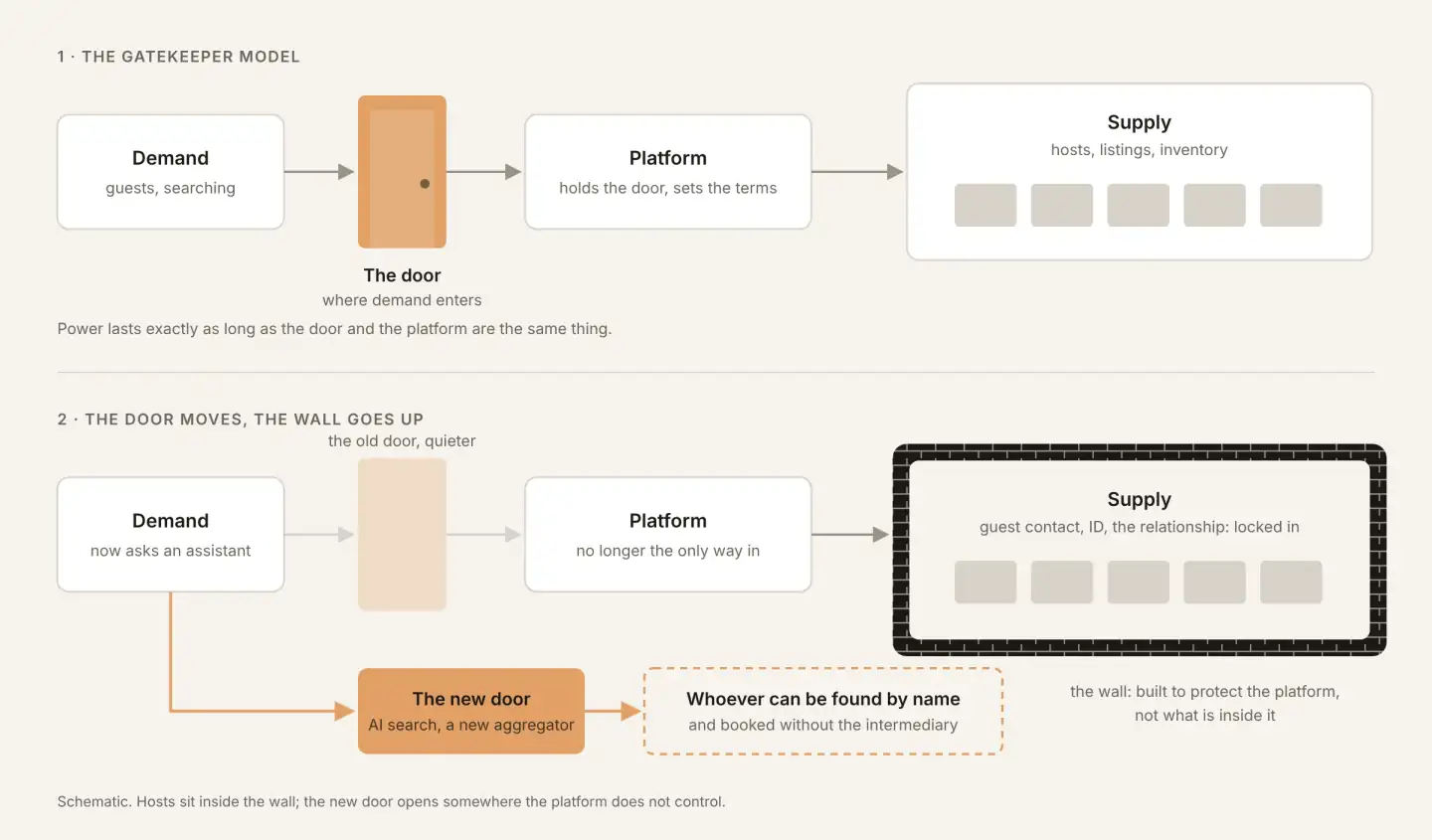
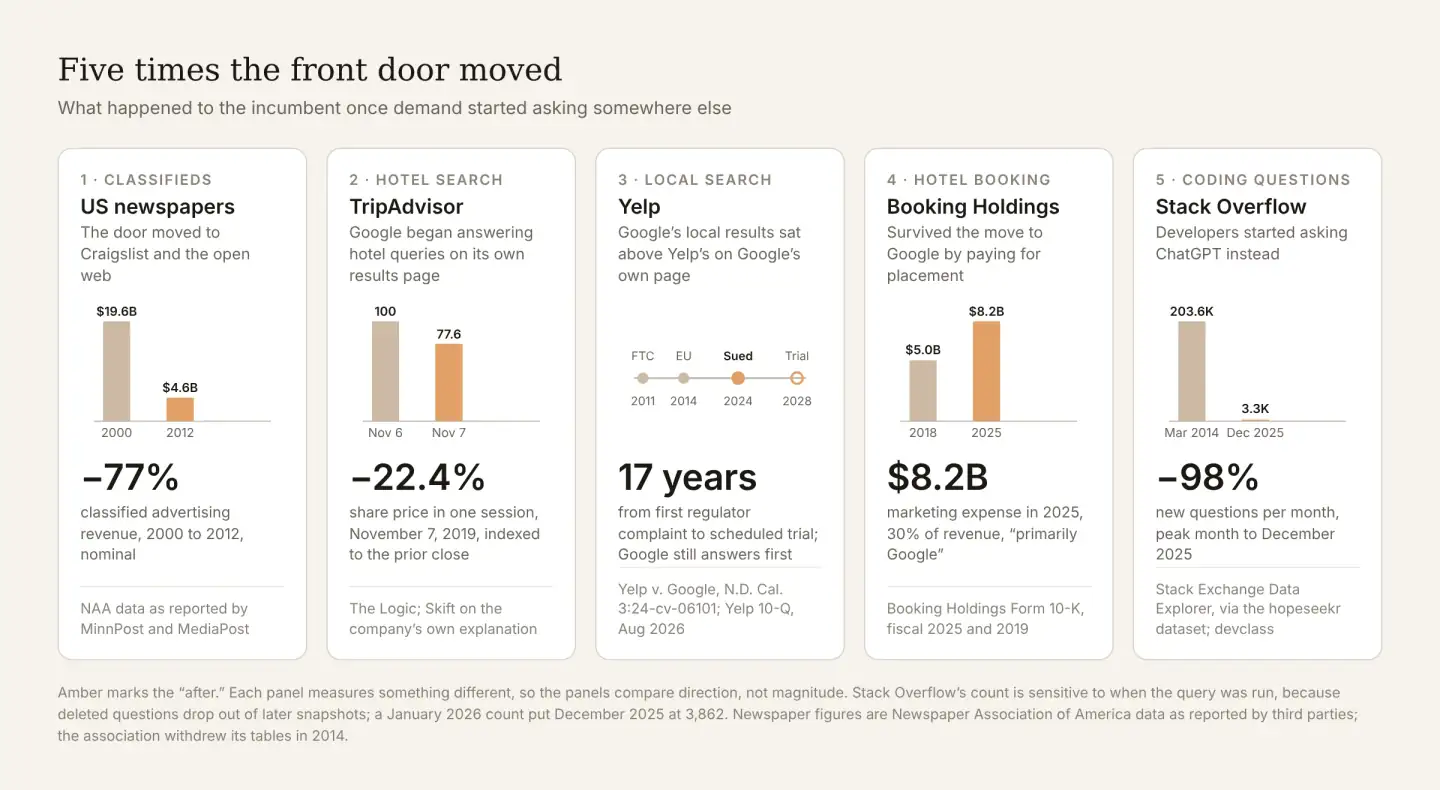
A platform that sits between supply and demand earns its margin by being the place demand shows up. Its power over supply lasts exactly as long as that remains true. Five times in the past quarter century the place has moved, and each time the incumbent reached for the same lever.
Newspapers and the classifieds. In 2000, American newspapers sold $19.6 billion of classified advertising, around two fifths of everything they earned from advertisers.10 Craigslist then offered the same listings for nothing. Robert Seamans and Feng Zhu, studying roughly a thousand local papers, found that classified-dependent titles cut their classified rates, raised subscription prices and lost circulation as Craigslist arrived in their cities; by their conservative estimate, buyers of classified ads saved $5 billion between 2000 and 2007.11 By 2012, classified revenue had fallen to $4.6 billion. The association stopped publishing the figure the following year.10
TripAdvisor and Google's hotel answers. On November 6, 2019, TripAdvisor told investors that its "most significant challenge remains Google pushing its own hotel products in search results and siphoning off quality traffic."12 The next day its shares closed down 22.4 percent, having fallen as much as 28 percent intraday, the worst session in the company's history.12, 13 Google had simply begun answering the hotel question before anyone clicked through to a review site.
Yelp and local search. Yelp has complained about the same mechanism since 2011, first to American regulators, then to the European Commission in 2014, and on August 28, 2024 in a federal lawsuit that opens by calling Google "the largest information gatekeeper in existence."14 The case has gone better than most: in April 2025 the court let Yelp's core monopolization claims proceed, in October 2025 it revived the tying claim, and in mid-2026 it ruled that Google may not relitigate the monopoly findings from the Justice Department's case.15 Trial is scheduled for September 2028. In the meantime Google's local results still sit where they have sat for a decade, above Yelp's.
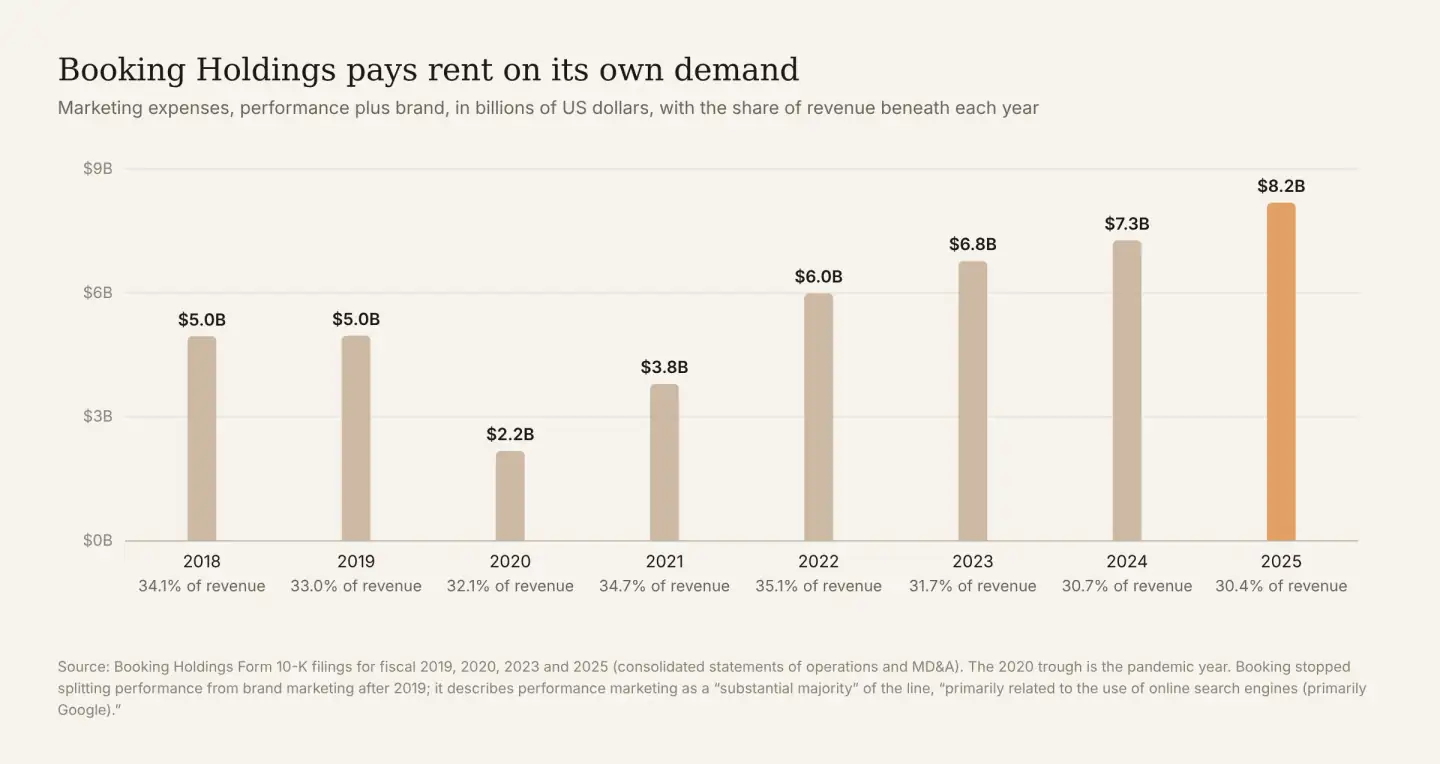
Booking Holdings paid rent. Booking.com survived the move to Google by buying its way back in. Its marketing line was $8.2 billion in 2025, 30 percent of revenue, and the company says performance marketing, "primarily related to the use of online search engines (primarily Google)," makes up a substantial majority of it.5 The line has consumed roughly a third of revenue every year since 2018. A gatekeeper that loses the door can keep its business by paying the new doorkeeper, and Booking is proof that the toll never stops.
Stack Overflow and ChatGPT. The programming forum received 203,607 new questions in March 2014, its best month. Volume had been drifting down for years, but the slope broke in November 2022. Within six months of ChatGPT's release, a peer-reviewed study found activity on the site had fallen 25 percent relative to comparable forums where ChatGPT was unavailable or weak, a figure the authors call a lower bound.17 By December 2025 the monthly count was below 4,000, roughly 98 percent under the peak, and by May 2026 it was under a thousand.16 Nobody beat Stack Overflow. Developers started asking somewhere else.
When the door moves
The refrain writes itself: when the door moves, the gatekeeper loses its grip. The detail worth holding onto is how. In none of the five cases did a rival build a better newspaper, a better review site or a better forum. Demand took its first question somewhere new, and the incumbent's hold, which had always rested on being the place that question was asked, went with it.
What the gatekeepers did on the way down is the part hosts should study. Newspapers raised subscription prices on the readers they still had. TripAdvisor and Yelp went to court. Booking went to its checkbook. Each response squeezed, or spent on, the side of the market the incumbent still controlled.
Airbnb's turn
Map the pattern onto Airbnb and the November 20 rules stop looking like a guest-experience project. The new door is AI search and the agents behind it, which Chesky says Airbnb does not yet work inside. The wall is the policy. The mechanism is data. A guest whose email, phone number and ID the host may not hold is a guest who can only be reached through Airbnb's inbox, under Airbnb's rules, for as long as Airbnb allows. The accompanying bans on separate rental agreements, host-set fines and off-platform reviews each close another path by which a guest found on Airbnb might become a guest reachable anywhere else.3 Hosts sit inside that wall. It was built around them, and it was built for Airbnb.
The strongest objection deserves a fair hearing. Guests have good reasons not to hand a passport photo to a stranger, trust is the product a marketplace sells, and Airbnb says plainly that the policy is about privacy. Grant all of it. The effect on hosts does not change with the motive. A policy can be good for guests and still leave the host unable to invite them back, and a platform that benefits from that outcome does not need bad intentions to arrive at it. Motive is the question hosts keep arguing about. Mechanism is the one that decides their business.
Who survived
Look across the five cases for what the survivors had in common and the answer is less inspiring than a strategy deck, and more useful. They could be found by name and reached directly. The newspapers still standing are the ones readers pay for by title. The hotel chains built loyalty programs so that a traveler had a reason to type the brand into the address bar rather than a search box. Booking pays its rent to Google, but it also reports that a mid-fifties percentage of its 2025 room nights came from people who arrived at its platforms directly, a share that rose over the year.5 That direct mix is what the $8.2 billion protects.
None of this is motivational. It is arithmetic. When the place demand starts moves, a business demand can still find without the door keeps its customers; a business reachable only through the door keeps whatever the doorkeeper allows. Airbnb understands this about itself, which is why it is building an agent rather than joining someone else's directory. Hosts should understand it about themselves. Our research on AI and lodging distribution found no evidence yet that assistants have shifted transaction share toward small operators; what they have done is make an unknown property easier to consider. That opening is worth something only to a host who can be found and booked at the end of it.
A door of your own
The guest on Airbnb was never the host's. The November 20 policy does not change that; it writes it down. What has changed is the urgency. The door is moving, the platform knows it, and its response is to hold the guests it has more tightly. Before it moves again, a host needs a door of their own: a name guests can search for, and a place to book without the intermediary in between.
That is what Haven builds, a direct booking website under the host's own name with no booking commission, and the reason we started writing about why guests remember Airbnb and not your rental long before this October.
FAQ
Did Airbnb remove host access to guest phone numbers and email addresses?
Airbnb does not give hosts a guest's email address; messages pass through its own inbox and relay addresses. From November 20, 2026, the new policy bars hosts from asking for an email, phone number, home address or ID at any point in the booking or stay, and from keeping a copy of an ID checked in person. Separately, in parts of the US and Canada, the phone number shown to a host is a temporary Airbnb number that expires two days after checkout.
What exactly did Brian Chesky say about Airbnb and AI?
In a TechCrunch interview published October 1, 2026, Chesky said: "I've used Airbnb on Muse and Instinct. And it doesn't work very well. I mean, even hotels don't work that well, but Airbnbs work even worse." Muse and Instinct are consumer AI agents. On Airbnb's May 7, 2026 earnings call he said chatbot design "as it's currently constructed today, does not work for travel or ecommerce."
How far have Stack Overflow questions really fallen?
New questions per month peaked at 203,607 in March 2014. A Stack Exchange Data Explorer snapshot from 2026 puts December 2025 at 3,330, and a count run in January 2026 put it at 3,862; both are about 98 percent below the peak. May 2026 was under a thousand. The figure moves because deleted questions drop out of later snapshots, so quote the month and the snapshot together.
Sources
Reviewed October 28, 2026. Figures were checked against the primary document where one is public; where only secondary reporting of a primary dataset survives, that is noted.
- Airbnb Resource Center, "Important changes to house rules," October 20, 2026; Airbnb Help Center, "Reasonable house rules and requests," effective for reservations booked on or after November 20, 2026.
- Dennis Schaal, "Airbnb's New Policy for Hosts: Don't Ask Guests to Wash Dishes or Strip Beds," Skift, October 21, 2026; Charlotte Reck, "Airbnb rule change frees guests from chores involving 'significant effort'," CNN, October 22, 2026; Associated Press, "Airbnb guests no longer have to wash the dishes or strip the beds at checkout," October 22, 2026.
- Airbnb Help Center, "Limiting host-imposed contracts and other requirements," applying to reservations booked on or after November 20, 2026. The page also carries the superseded Off-Platform Policy for earlier bookings.
- Airbnb Help Center, "How temporary phone numbers work." Airbnb describes the feature as available "to a limited number of users in the United States and Canada." The rollout date is not stated on the page.
- Booking Holdings, Form 10-K for fiscal 2025, filed February 2026: marketing expenses of $8,186 million against revenues of $26,917 million; the "substantial majority" and "primarily Google" language; the Gen AI risk factor; and the "mid-fifties percentage" direct mix. Earlier years from the fiscal 2023, fiscal 2020 and fiscal 2019 filings.
- Natalie Lung, "Chesky says OpenAI tools not ready for ChatGPT tie-up with Airbnb app," Bloomberg via Fortune, October 21, 2025. Our earlier piece on why ChatGPT cannot book an Airbnb covers the robots.txt rules behind it.
- Ivan Mehta, "Brian Chesky interview: AI agents need their own operating system," TechCrunch, October 1, 2026. The quotation is verbatim; Muse and Instinct are consumer AI agents, and the remark is not about ChatGPT.
- Airbnb, Q1 2026 earnings call transcript, May 7, 2026, from Airbnb Investor Relations.
- Skift, reporting from Skift Global Forum, September 23, 2026, as covered in our note on Airbnb's 2027 agent.
- Newspaper Association of America classified revenue, as reported by MinnPost, "How Craigslist killed the newspapers' golden goose," February 2014 ($19.6 billion in 2000; $4.6 billion in 2012; roughly 40 percent of newspaper ad revenue in 2000), and MediaPost, "Ad Spending in Newspapers Hit $48.7 Billion in 2000." The association stopped releasing the series in 2013, per Poynter, so no primary table is online; the two figures are consistent across the secondary reports we checked.
- Robert Seamans and Feng Zhu, "Responses to Entry in Multi-Sided Markets: The Impact of Craigslist on Local Newspapers," Management Science 60, no. 2 (2014): 476–493, doi:10.1287/mnsc.2013.1785; findings summarized in NYU Stern's release, August 13, 2013.
- Liza Agrba, "As their shares tank, Expedia and TripAdvisor blame Google," The Logic, November 8, 2019 (TripAdvisor closed down 22.41 percent); Dennis Schaal, "Google's Travel Gains Levy Pain at TripAdvisor and Expedia," Skift, November 7, 2019, quoting TripAdvisor's prepared remarks.
- Bloomberg, "Google's Search Ad Embrace Crushes Online Travel Agents," November 8, 2019 (intraday fall of as much as 28 percent, the largest one-day loss in the company's history). TripAdvisor's 23 percent fall on November 7, 2017 was attributed by Reuters to Airbnb and hotel direct booking, not Google, and is not used here.
- Yelp Inc. v. Google LLC, No. 3:24-cv-06101 (N.D. Cal., filed August 28, 2024), complaint, paragraph 2; Jeremy Stoppelman, "Yelp v. Google," Yelp blog, August 28, 2024; TechCrunch, "Yelp files formal EU complaint," July 9, 2014.
- Order on motion to dismiss, Dkt. 47, April 22, 2025; Editor & Publisher, "Yelp can proceed with tying claim," October 23, 2025; PYMNTS, "Judge lets Yelp use DOJ's search monopoly findings against Google," July 2, 2026. The September 2028 trial date is from Yelp's Form 10-Q for the quarter ended June 30, 2026, Legal Proceedings; we read that line in an index excerpt rather than the filing itself.
- Monthly new-question counts from the Stack Exchange Data Explorer, compiled in Theodore Smith's public dataset (203,607 in March 2014; 3,330 in December 2025; 976 in May 2026); Tim Anderson, "Dramatic drop in Stack Overflow questions as devs look elsewhere for help," devclass, January 5, 2026 (3,862 in December 2025); Gergely Orosz, "Stack Overflow is almost dead," The Pragmatic Engineer, May 2025.
- R. Maria del Rio-Chanona, Nadzeya Laurentsyeva and Johannes Wachs, "Large language models reduce public knowledge sharing on online Q&A platforms," PNAS Nexus 3, no. 9 (September 2024), doi:10.1093/pnasnexus/pgae400. The measure is weekly posts, questions and answers combined.