Airbnb Bans Rental Agreements, ID Checks and Host Fines From November 20

On October 20, 2026, Airbnb emailed hosts a notice titled "Important changes to house rules." The subject line undersells it. Two policies take effect on November 20, and between them they remove four things a host has always been able to ask of a guest: a signed rental agreement, a copy of an ID, a fine for breaking the rules, and a checkout list that goes further than putting dishes in the sink.
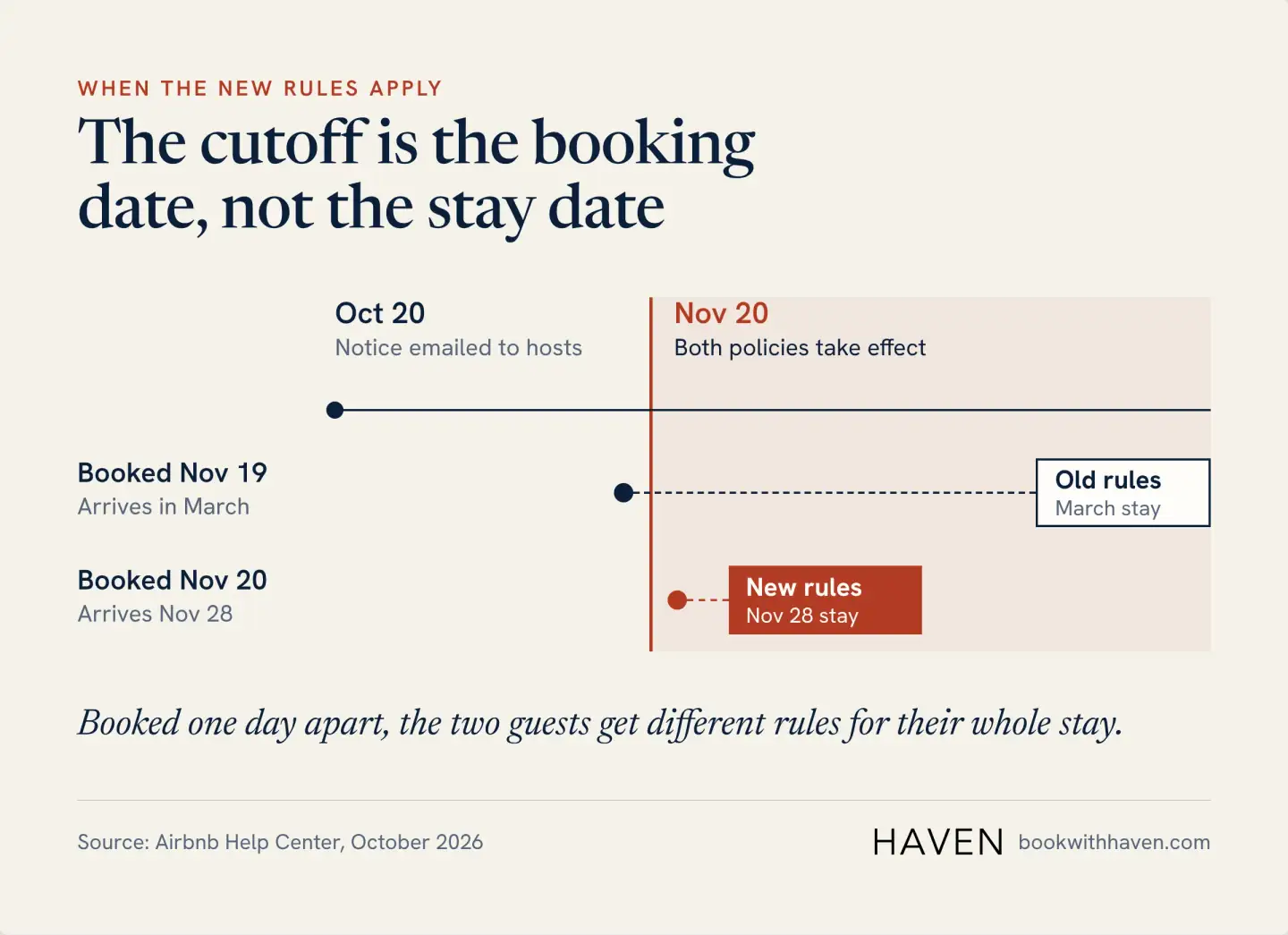
The first policy is a rewrite of the old Off-Platform Policy, now titled "Limiting host-imposed contracts and other requirements." The second is new, "Reasonable house rules and requests," and it replaces free-text house rules with seven standard rules plus a category Airbnb calls Requests. Both apply by booking date, not stay date, so a reservation made on November 19 runs under the old terms even if the guest arrives in March.
Key facts
- Both policies apply "to all reservations booked on or after November 20, 2026," according to Airbnb's Help Center. Earlier bookings keep the rules in place when the guest booked.
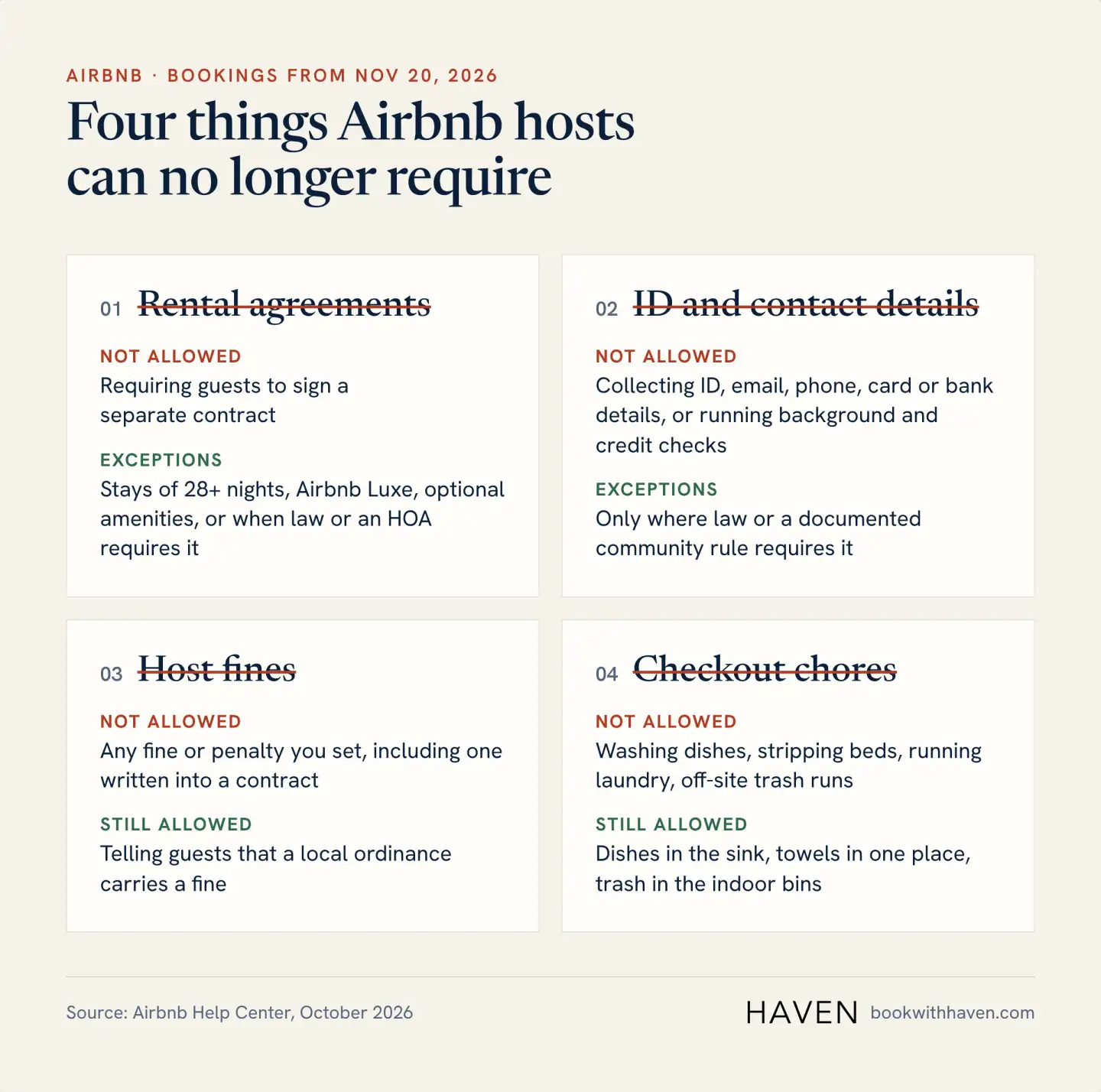
- Hosts "generally may not require guests to sign a separate contract or rental agreement." The exceptions are stays of 28 nights or more, Airbnb Luxe listings, a contract for an optional amenity such as a golf cart, and contracts required by law or a community association.
- Hosts may not collect contact information, identification documents, card or bank details, background or credit checks, or biometric or health data during booking or the stay, except where law or a documented community rule requires it.
- House rules are limited to seven standard options. Anything else is a request, which guests are "encouraged" to follow but not bound by.
- Asking a guest to wash dishes, strip beds, run laundry or take trash off-site is no longer allowed. Fines and penalties set by the host are banned outright.
- Repeat violations can bring a notice on the listing page, lower search placement, and action under the Terms of Service. Skift reported that this can include cancelled bookings, loss of Superhost or Guest Favorite status, and account suspension.
The contract ban
Airbnb's position on rental agreements has been drifting for years. The previous policy let a host require one as long as its terms were disclosed in the listing and in the message thread, and it warned that a guest could decline to sign after booking and request a full refund if the host had not disclosed it. The new text drops the conditional language. A separate contract is now the exception, not a disclosed option.
The four exceptions are narrower than they look. The monthly-stay carve-out covers 28 nights or more, which excludes nearly all vacation inventory. The legal and community-association exception requires the rule to be documented, and Airbnb says it may ask for proof. The amenity exception applies to the amenity, not the stay, so a golf-cart waiver cannot carry a damage clause for the house. Luxe is invitation-only.
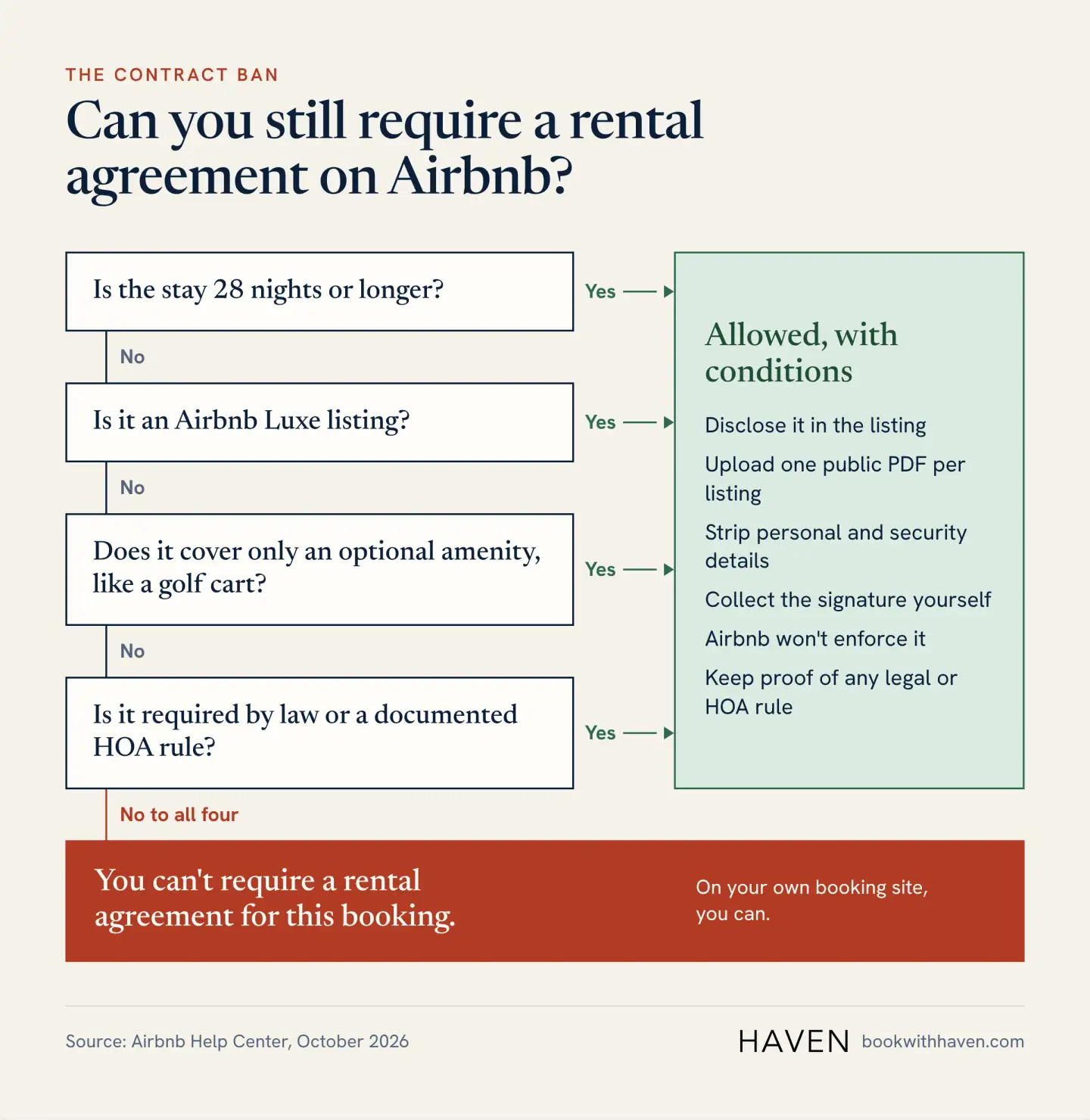
Where a contract is still allowed, the mechanics have changed too. Each listing can hold one publicly visible PDF, which means personal details and property-specific security information have to come out of it. Airbnb collects no signatures and enforces nothing: "we don't help enforce or require guests to sign contracts." The host gathers the signature, and the contract sits outside anything Airbnb will act on.
For a single home with a weekend minimum, the practical effect is that the agreement most property managers have sent to every guest for a decade cannot be sent to an Airbnb guest after November 20.
What hosts can no longer collect
The data rules go further than the old ban on asking for contact details before booking. The new list of prohibited collection covers the whole stay:
- Contact information, including email addresses and phone numbers
- Identification documents
- Credit card or bank details, except as permitted under Airbnb's pricing and payment transparency policy
- Background check or credit history information
- Biometric or health data
The exceptions mirror the contract rules: a legal requirement, a documented community rule, or a signature on an allowed contract. Where one applies, the host must say in the listing what is required and why, collect no more than necessary, and store and dispose of the data securely.
Two adjacent rules close the usual workarounds. A host may not require a third-party app or an account on another website to enter the home or use a critical amenity, and must offer a non-app alternative when a guest asks for one. And a host may not ask a guest to leave a review or complete a survey anywhere other than Airbnb, unless the listing is a hotel.
Airbnb is explicit that this is about the guest's privacy, and the reasoning is sound from a traveler's seat. For a host, the consequence is that a guest delivered by Airbnb is a guest Airbnb keeps. That has always been the quiet cost of the platform, and from November 20 it is written down.
Seven house rules and a list of requests
The house rules editor changed on October 20, a month ahead of the policy. Hosts now set standard rules for:
- Maximum overnight guests
- Quiet hours
- Events
- Pets, including how many
- Smoking, including vaping
- Commercial photography and filming
- Lock up at checkout, with optional notes on where to leave keys
Two of those are new: the guest cap and the lock-up rule. Everything else a host wants to say goes under Requests, and requests have to be "reasonable," a word Airbnb defines by example rather than by principle.
| Area | Allowed as a request | Not allowed |
|---|---|---|
| Dishes | Put used dishes in the sink | Wash and put them away |
| Laundry | Gather used towels in one place | Strip the beds or start a wash |
| Trash | Sort into the indoor bins | Take trash to an off-site dumpster |
| Utilities | Turn off the air conditioning on departure | Ask guests not to use a listed amenity |
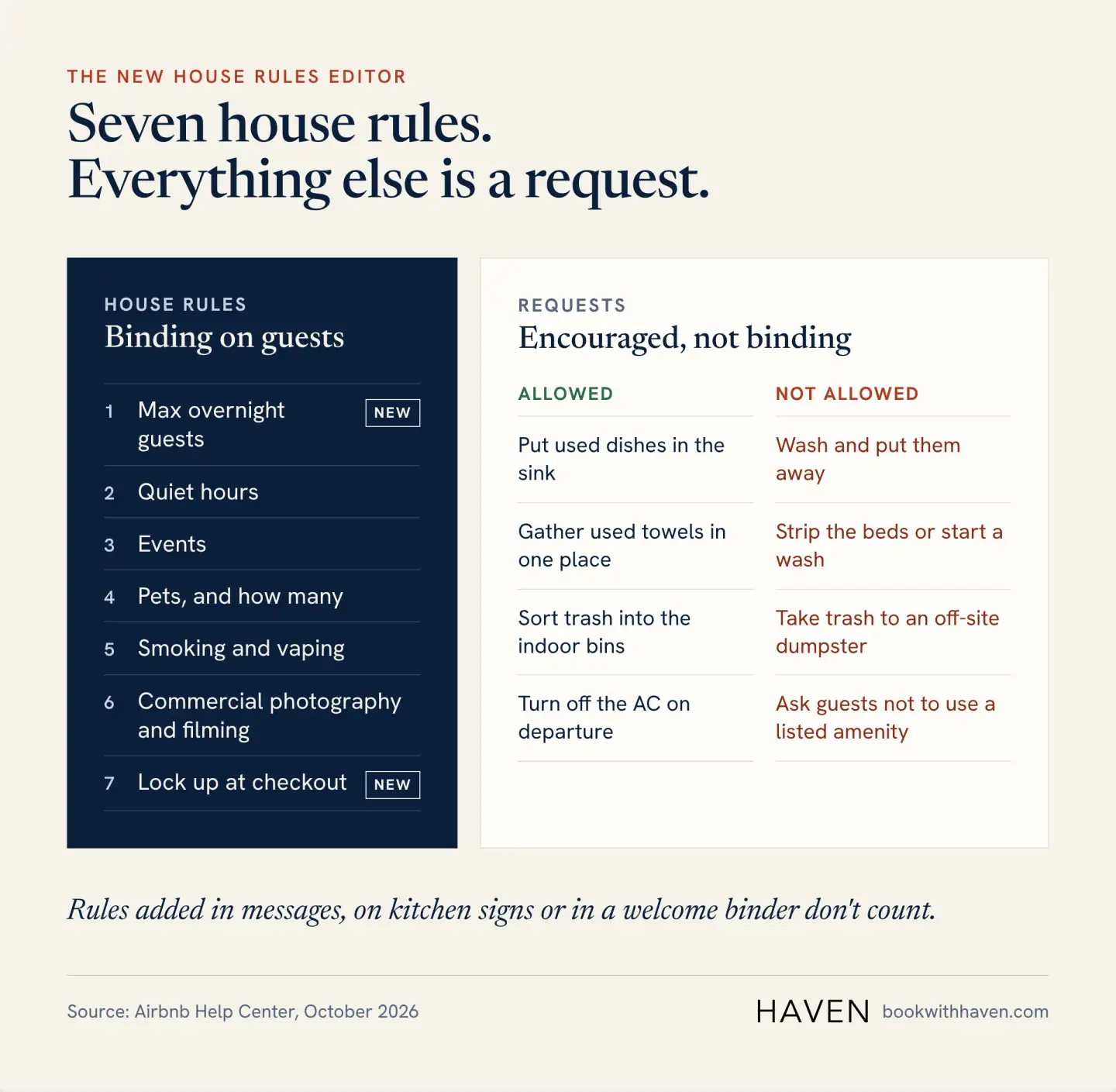
The policy also bars restricting access to any advertised feature, hiding fees for advertised features outside the booking price, and any fine or penalty set by the host. A host may notify guests that a local ordinance carries a fine, but may not levy one.
Airbnb says it will weigh "local considerations," and offers two examples of exceptions it might grant: animal-proof trash containers in bear country, and shower time limits during a drought restriction. Hosts in either situation can expect to document it.
Rules only count in the designated section. Anything added in a message, on a sign in the kitchen, or in a welcome binder "may not" be used to introduce new rules, which ends the practice of sending the real house rules after the booking confirms.
Fines, damage and the deposit question
The ban on host-imposed fines rests on AirCover. Airbnb's reasoning is that property damage is already covered, so a host has no need to set a smoking penalty or an extra-guest charge. The April 2026 terms update tightened what AirCover accepts: claims are due within 14 days or before the next check-in, AI-edited photos are excluded, and the evidence standard is now "legitimate and verifiable". A host who loses the ability to charge a fine and gains a narrower claims process has less recourse than before, not the same amount in a different form.
Security deposits were already restricted on Airbnb. The new policy does not change that; it removes the last informal substitute, which was a fine clause in a contract the guest signed. A card hold on a direct booking remains the only version of a deposit a host controls end to end.
How enforcement works
Airbnb has built the enforcement into the editor. Text that looks non-compliant is flagged as the host types it. A request saved despite the flag goes to review, and the host receives an email with resolution tips and a chance to appeal. From there the ladder runs: education, a warning, a notice on the listing page that guests see (Rental Scale-Up reports wording along the lines of "includes cleaning requests"), reduced search visibility, and "other actions under our terms of service."
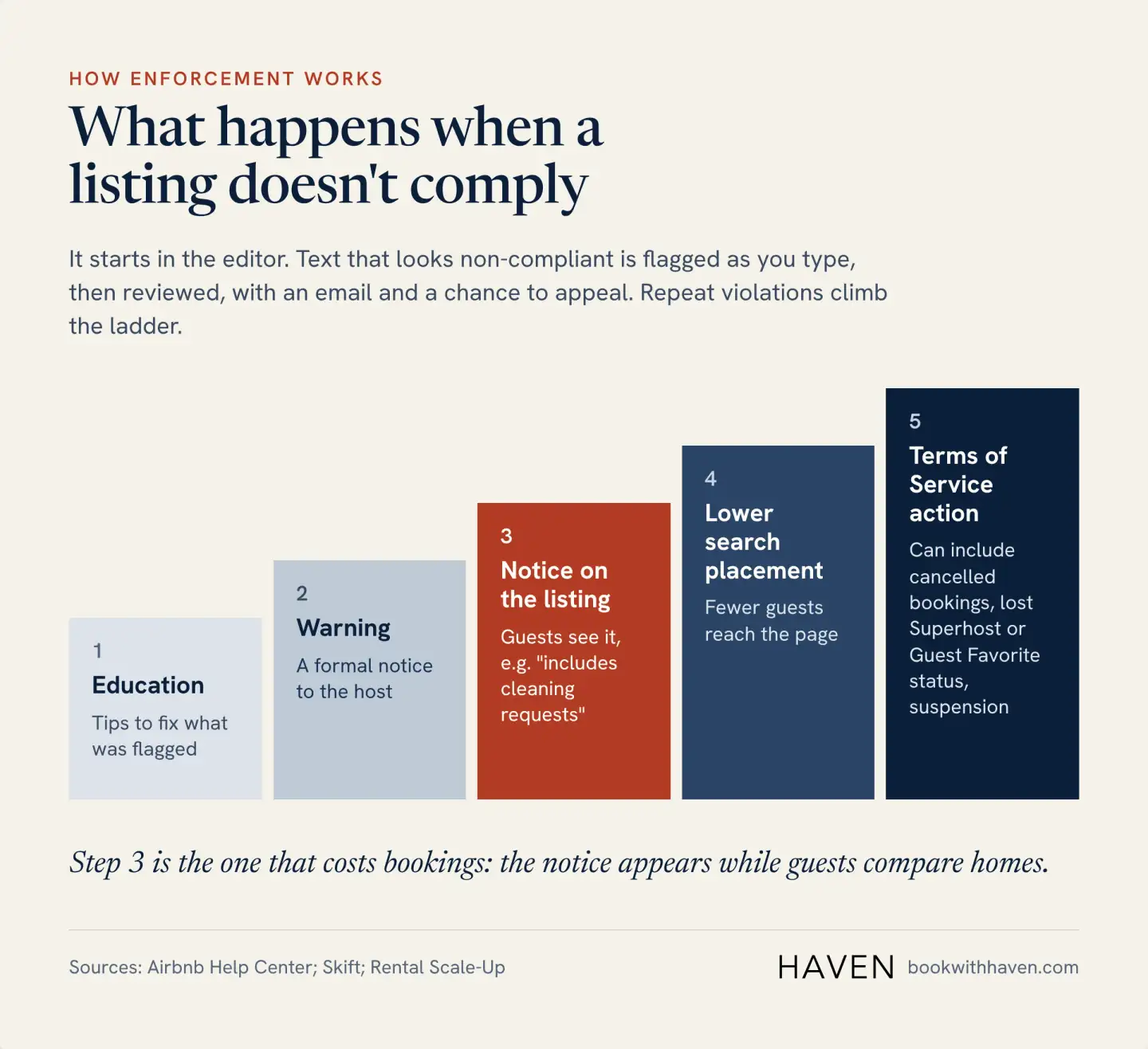
The listing notice is the step that matters. It appears at the moment a guest decides between two homes, and lower search placement means fewer guests ever reach the page.
Host reaction arrived within a day. Skift counted about a dozen objections on Airbnb's Community Center by the afternoon of October 21, most of them about the dishes rule, with two French hosts saying they might leave the platform. A Quebec City property manager told the same reporter that absorbing changes like this is simply part of professional management. Both views are right, and that is the tension the policy creates: the hosts best placed to comply are the ones running full turnovers already.
What to do on Airbnb before November 20
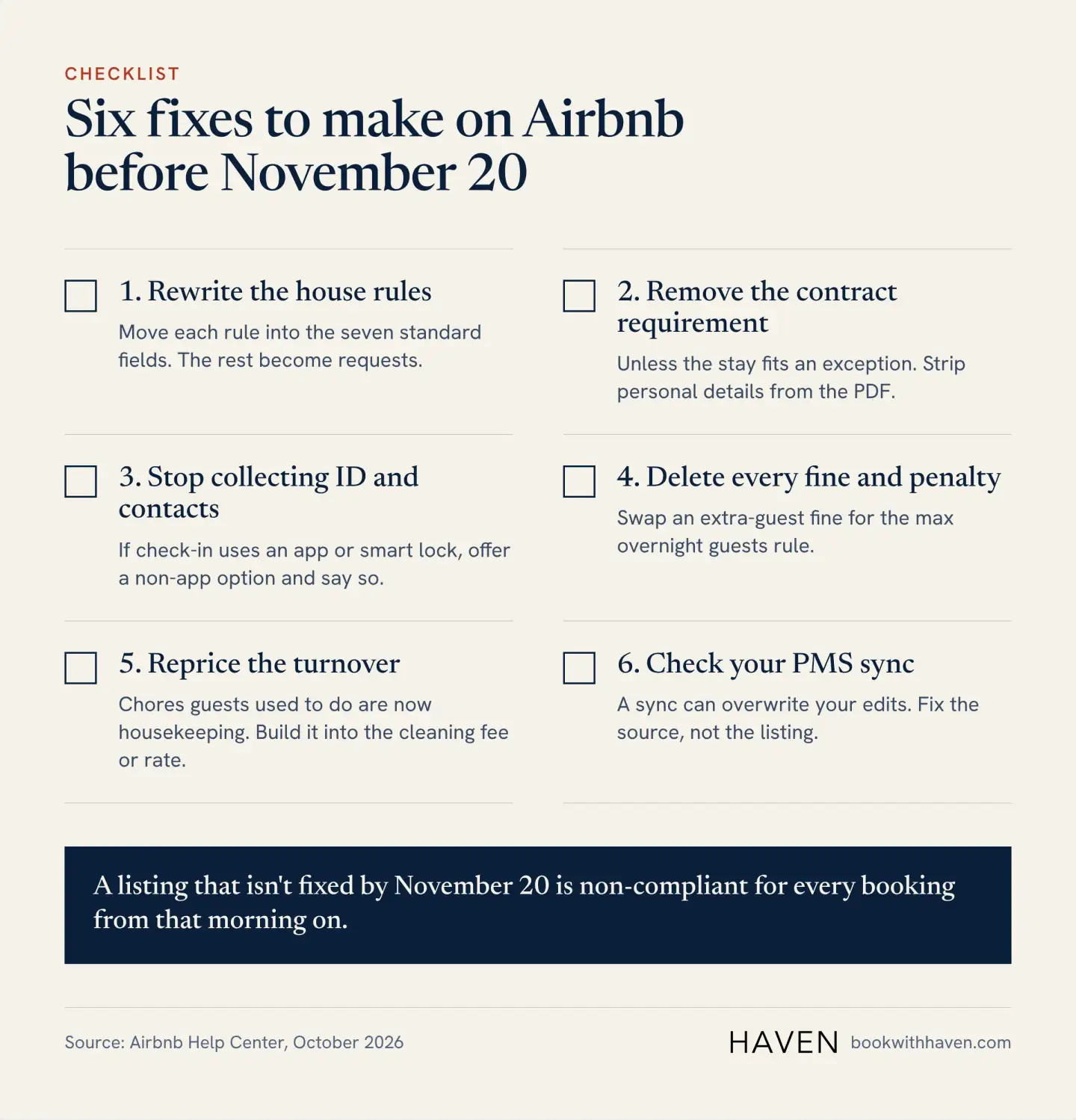
The cutoff is the booking date, so a listing that is still non-compliant on November 20 is non-compliant for every booking from that morning on. In order of consequence:
- Rewrite the house rules. Move each rule into one of the seven standard fields. Put the rest under Requests and run them against the table above. Anything the editor flags will be reviewed.
- Remove the contract requirement unless the stay fits an exception. If it does, strip personal information from the PDF before uploading it, and keep the documentation that justifies it.
- Stop collecting ID and contact details from Airbnb guests. If a smart lock or guest app is part of check-in, add a non-app alternative and say so in the listing.
- Delete every fine and penalty clause. Replace an extra-guest fine with the maximum overnight guests rule, which gives you a no-penalty cancellation right if a guest breaks it.
- Reprice the turnover. If guests were stripping beds and running the dishwasher, housekeeping now does it. That cost belongs in the cleaning fee or the nightly rate, not in a request Airbnb will flag.
- Check the sync. A property management system that pushes house rules to Airbnb may overwrite the edits on its next run. Fix the source, not the listing.
What you can still do, and where
None of these rules apply to a booking made on your own website. A direct guest can sign a rental agreement before paying, verify their identity, accept a card hold, agree to the checkout standard you set, and give you an email address you are allowed to use. The host sets the cancellation policy too, including the Strict terms Airbnb retired for new listings last year.
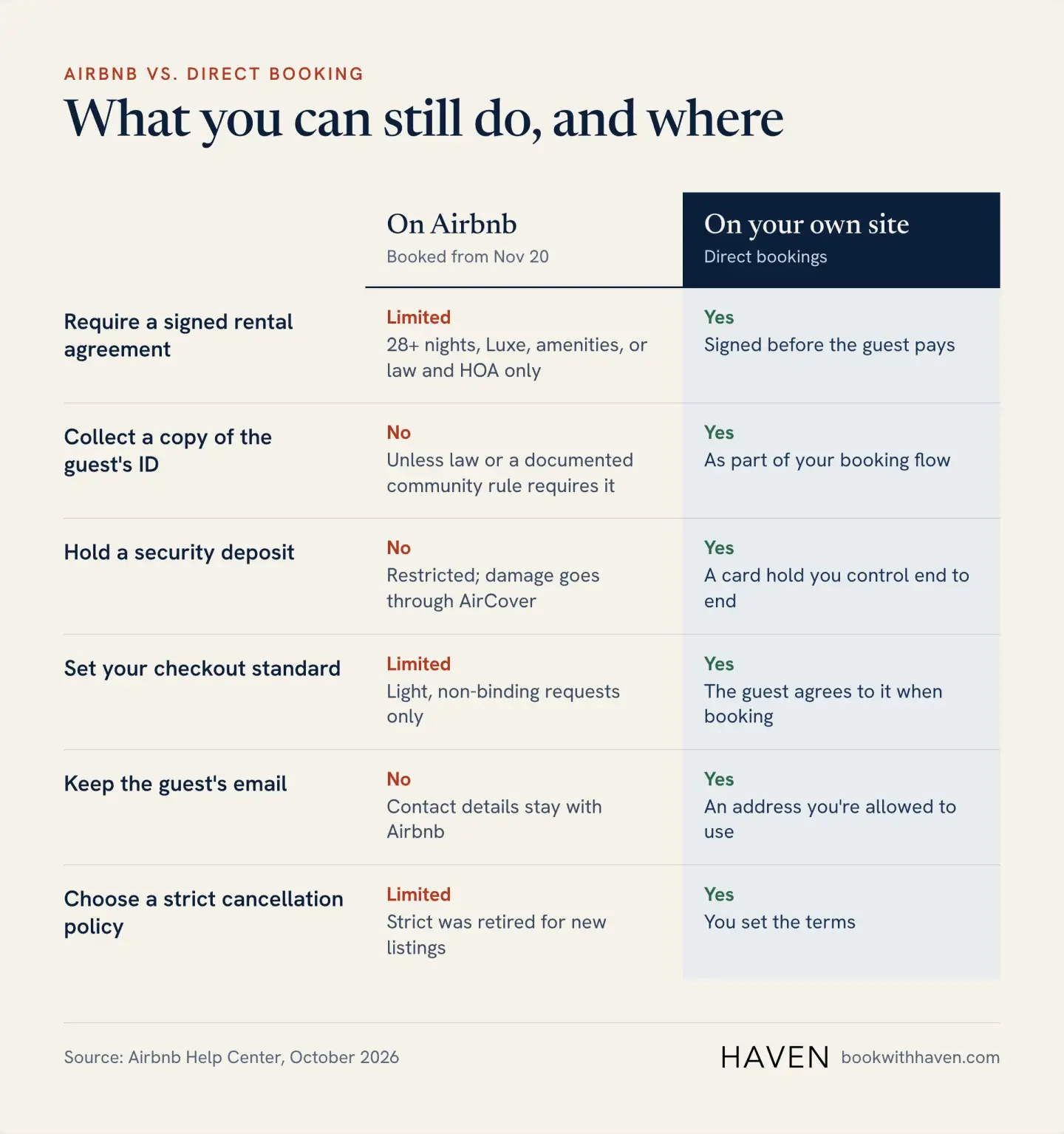
That is not an argument for leaving Airbnb. Most hosts will keep listing there, and the policy is manageable for anyone who already runs a complete turnover. It is an argument for being precise about which guests you have a relationship with. Airbnb's own rules on contacting guests have not loosened, so a direct guest list has to be built from direct bookings and guests who opt in, never from the Airbnb inbox. Airbnb's share of professionally managed U.S. reservations rose to 50% in the first quarter of 2026 while direct fell to 23%, according to Haven's research on booking beyond the OTA. The hosts who reverse that for their own portfolio will be the ones who treated the November 20 change as a reason to make the direct channel the place where the full rental business lives.
FAQ
Does the policy apply to bookings I already have? No. It applies to reservations booked on or after November 20, 2026. A booking made before that date keeps the rules and any contract that were in place when the guest booked.
Can I still check a guest's ID at check-in? Yes, if it is disclosed. Airbnb's policy says hosts "may physically check a guest's ID to verify identity in person at check-in" when the requirement is stated in the Requests section of the listing. Keeping a digital or physical copy is prohibited unless a legal, community-rule or allowed-contract exception applies.
My HOA requires a signed rental agreement. What changes? Nothing about the requirement, but the mechanics do. Disclose it in the listing, upload one PDF with no personal information, collect the signature yourself, and keep the HOA rule on file in case Airbnb asks for proof.
Can I charge an extra-guest fee? A fee disclosed in Airbnb's pricing fields is a fee. A charge triggered by breaking a rule is a fine, and fines are banned. Set the maximum overnight guests rule and treat an overage as a rule violation instead.