Vacation Rental SEO and AI Search, Minus the Folklore

Picture a lake house with a perfectly respectable website. The description is honest, the photographs are good, the calendar works. Three months after launch, a search for a lake house on that very lake returns two marketplaces, a property manager, and no sign of the host who built it.
The tempting next move is to hire whoever promises to fix it. Search advice arrives with remarkable confidence and very little paperwork: one expert calls a tactic essential, the next calls it obsolete, and neither cites anything a search engine has published. Hosts hear more of this than most, because a rental site depends on being found, and anxiety sells well.
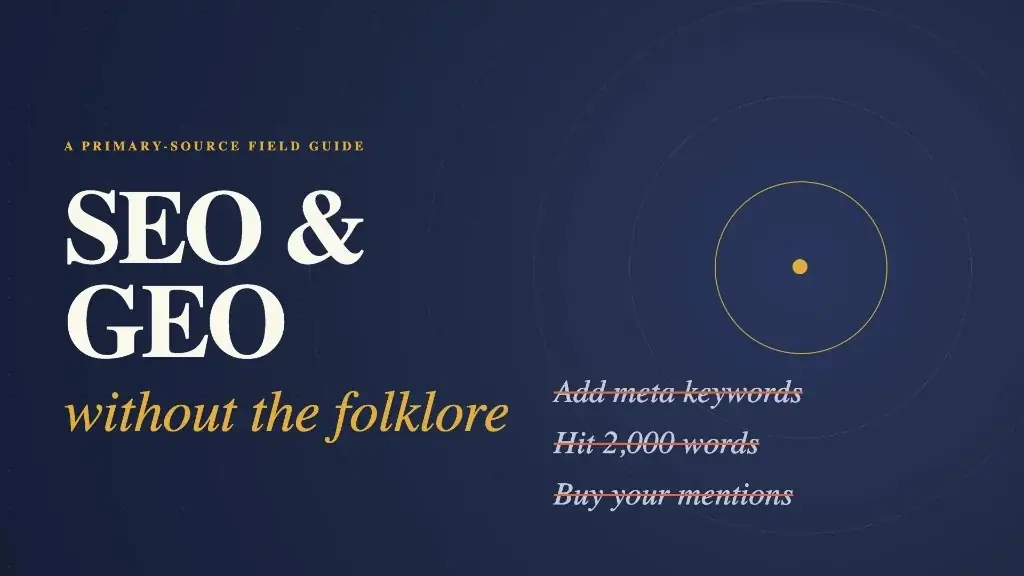
We wanted something sturdier, so we wrote it. SEO & GEO Without the Folklore is a fifteen-page field guide built only from what Google, Microsoft, Schema.org, and the AI companies have committed to in writing. Where their documents go quiet, the guide says "unknown" and leaves the gap unfilled. This article is the guided tour. The guide is the map, with a source beside every claim, and you can download the free PDF to keep it open as you read.
Google sets expectations on the first page of its own starter guide: there are "no secrets here that'll automatically rank your site first in Google." A good place to begin.
Seven places a page can go missing
Before a traveler ever sees your site in a result, an engine has to learn the page exists, fetch it, run its scripts, decide whether to keep it, match it to a question, weigh it against rivals, and finally draw it on the screen. Each step can fail on its own, and each fails differently.
That sequence changes how a problem should be diagnosed. Crawled, indexed, ranked, and clicked are four separate outcomes, and earning one says nothing about the next. Google states plainly that not every page will be stored, and that a stored page "is not guaranteed" to be shown. A beautifully rewritten description does nothing for a page the engine never kept. Find the earliest stage that broke, repair it, and only then turn to the stages downstream.
Google Search Console, which is free, reports which stage a page failed. Rental sites tend to stumble over a short list of ordinary causes: a page nothing links to, a property card that opens through a script instead of a real link, or a booking calendar that spawns hundreds of near-identical addresses (one for every date and guest count) until the engine can't tell which version is the actual house.
Then comes the hardest instruction in the guide, and it belongs to Google: "Some changes might take effect in a few hours, others could take several months." Give any fix a few weeks before you judge it.
Myths Google has retired in its own words
A surprising share of popular advice has been contradicted outright by the engine it claims to decode. A partial list, in Google's phrasing:
- The meta keywords tag has "no effect on indexing and ranking at all."
- Word count is no lever. "The length of the content alone doesn't matter."
- Sixty-character titles and 160-character descriptions are habit, not rule. There is "no limit" on title length; the display is simply trimmed to fit the device.
- E-E-A-T, the acronym that appears in every SEO audit, is a framework for Google's human quality raters. Asked whether it is a ranking factor, Google answered: "No, it's not."
- Buying Google Ads has "no impact on your organic search ranking."
- Keywords in your domain name "have hardly any effect beyond appearing in breadcrumbs."
- Duplicate content on your own site is "normal" and "not a violation." Wasteful, perhaps. Penalized, no.
None of this makes SEO imaginary. What it dismantles is the scoreboard version, a list of weighted factors that Google has never published. The company describes ranking systems, each with a stated purpose and none with published inputs, and notes that "the weight applied to each factor varies depending on the nature of your query." There is no formula waiting to be reverse-engineered, which is worth remembering the next time someone offers to sell you one.
Four places your words carry weight
Beneath all the keyword mysticism sits one plainly documented signal. In Google's words, "the most basic signal that information is relevant is when content contains the same keywords as your search query." Most basic, note, rather than strongest. Google's own illustration involves dogs: a person searching for dogs does not want a page that repeats the word hundreds of times. They want photographs, a list of breeds, something that helps. Completeness wins where repetition loses.
On placement, Google is unusually specific. It names four locations and no others: the page title, the main heading, image alt text (the short written description attached to a photo), and link text. Keyword density, "LSI keywords," and bolding every mention appear in no Google or Bing document.
For most hosts, the single most winnable search is the property's own name. Travelers who found you on a marketplace often type that name into Google to find you directly. Put it in the title of your page, and make sure the page that answers is yours rather than the listing.
That listing poses a quieter problem. Pasting your Airbnb description onto your own site carries no penalty, but it forfeits an advantage: Google's systems aim to show original work "ahead of those who merely cite it," and the marketplace publishes your words with far more links behind them. Write the site version fresh, and make it the fuller of the two.
Write what only someone who has slept there knows
Google offers creators no scored checklist. It offers questions, and several read as though they were drafted with a property page in mind. Does the content provide original information? Does it demonstrate first-hand experience? After reading, will someone know enough to achieve their goal?
For a host, the answers live in particulars. Which bedroom catches the morning sun. How far the dock sits from the waterline in a dry August. Where to park when the festival closes Main Street. A marketplace has no room for details like these, and a competitor has no way to copy them.
Google's 2026 guidance gives the idea a name, "non-commodity content," meaning takes that "go beyond common knowledge and the ordinary." The contrast is easy to picture. "Top 10 Things to Do in Bear Lake," stitched together from the tourism board, is commodity. "What we tell every guest about the road in February," accompanied by a photograph of the plow, is something else entirely.
Artificial intelligence is allowed in the kitchen. "Appropriate use of AI or automation is not against our guidelines," Google writes, though "using AI doesn't give content any special gains." The violation lies in churning out many pages that add nothing, a rule that applies "no matter how it's created." Let a tool help with the sentences; the first-hand facts still have to come from you.
Resist, too, the urge to redate old pages. Changing a date on content that hasn't meaningfully changed sits on Google's list of warning signs. A festival weekend deserves fresh dates. How many the house sleeps does not.
And sign your work. Google "strongly encourage[s]" accurate bylines where readers expect them, and a host page with your name and a way to reach you fits that description exactly. Google stops short of claiming a byline lifts rankings. Guests deciding whether to trust a stranger with their vacation notice it anyway.
Tactics that look like marketing and read as spam
Google defines spam by intent, and several of its textbook examples map neatly onto rental websites:
- Twenty "cabin rental near [town]" pages that say the same thing and all funnel to one house. Google calls this doorway abuse. Area pages are fine when each one carries something genuinely distinct.
- A footer listing every town within sixty miles, which Google describes almost verbatim as keyword stuffing.
- "[Property] for [Holiday]" pages generated in bulk, whatever tool produced them.
- Paid directory links left unlabeled. Paid links are permitted; they simply have to be marked as sponsored.
Structured data, the behind-the-scenes code that labels a page's contents for machines, deserves its own caution. It can make a page eligible for a richer appearance in results, but Google is explicit that eligibility "does not guarantee" the feature, and markup is not a documented ranking factor. Two favorite rental tactics fall flat. Star ratings marked up from reviews of your own house are ineligible, because the business being reviewed controls those reviews. FAQ rich results, meanwhile, stopped appearing in Google Search in May 2026. Google does document a vacation-rental markup type, but it is reserved for partners connected through Google's Hotel Center, so adding it to an ordinary site produces nothing at all.
Reputation is the part you can't write yourself
Of all the quality inputs Google describes, the one it names most directly is whether "other prominent websites link or refer to the content." It is also the one signal no amount of editing can add to your own page. (A related aside: "domain authority" is a number invented by SEO software vendors. No search engine publishes it.)
Honest links for a rental tend to be local and specific. The chamber of commerce. The wedding venue whose guests fill your rooms every June. The regatta or trail race for which you are the nearest bed. The regional tourism site, or a local journalist writing about the lake. When someone agrees to link, ask them to describe you ("the lake house on the west shore") instead of writing "click here."
Reviews come with rules Google has written down in unusually firm language. Offering discounts or freebies in exchange for reviews is "strictly prohibited," and so is soliciting only the guests you expect to be delighted. Asking everyone is fine, and Google itself observes that "a mix of positive and negative feedback often feels more trustworthy."
One rule surprises nearly every host. An individual vacation rental cannot have a Google Business Profile; Google's policy lists vacation homes as ineligible by name. A management company with a staffed office that receives customers may qualify. We've written separately about who qualifies for a Google Business Profile and the surfaces hosts tend to confuse with it.
GEO is mostly SEO wearing a new badge
"Generative engine optimization" is the newest line on the invoice, promising visibility inside ChatGPT, Claude, Perplexity, and Google's AI Overviews. Google has addressed the term by name: "optimizing for generative AI search is optimizing for the search experience, and thus still SEO." Its closing advice is blunter: "Prioritize effective SEO strategies over 'AEO/GEO hacks'."
The reasoning is architectural. AI answers are assembled from search results. Google's AI features draw on its own index, and Microsoft notes that many language models rely on Bing's index or another search index. A page that can't be indexed can't be cited, which means everything earlier in this article already counts as GEO work.
Google also debunks, one by one, several products currently sold as AI optimization. Google Search doesn't use llms.txt files. There is "no requirement to break your content into tiny pieces," there is "no ideal page length," and there is "no special schema.org markup you need to add." Nor do you need to rewrite your pages in some imagined AI-friendly voice.
The single AI-specific task worth an afternoon is defensive. Many website platforms and content delivery networks offer a one-click "block AI" setting, and some of those presets turn away the crawlers that power AI search along with the ones that gather training data. The damage is silent: your property simply stops appearing in ChatGPT and Claude answers. Treat the two questions separately. OpenAI, for example, runs one crawler for search and another for training, and says "each setting is independent." Allow the search crawlers, then make your own decision about training. Google's equivalent control, called Google-Extended, governs Gemini training only and does not remove a site from AI Overviews. Our earlier piece on getting recommended by ChatGPT explains how to read your robots.txt file in about fifteen minutes.
What no provider documents, anywhere, is how a page that has been retrieved becomes a page that gets cited. OpenAI says only that "placement is not guaranteed." For the larger question of whether AI will actually shift bookings toward independent hosts, our research report on AI distribution and the future of direct booking weighs the evidence to date, and it is more sobering than the hype.
What nobody outside the engines knows
Google explains its own reticence: it must avoid revealing "too much detail that would allow people to game our search results." It also shipped 4,781 changes to Search in 2023, so any published formula would be stale before it was typeset.
That leaves a set of genuine unknowns. The weight of any individual signal. The value of any one link. What a particular core update changed, or why a given site rose or fell after it. How an AI assistant decides which retrieved page to cite. Anyone who quotes a precise number for one of these is quoting a hypothesis, and it is fair to ask for the source.
Knowing where the evidence ends turns out to be a kind of leverage. It lets you decline the next expensive promise with a clear conscience.
A month of work, in the order that matters
The field guide closes with a thirty-day plan that follows the pipeline from the top down. In brief:
- Find the broken stage. Verify your site in Google Search Console and Bing Webmaster Tools, read the indexing report, and confirm your robots file and CDN settings aren't turning search crawlers away.
- Tidy the addresses. One clean web address per house, with date and guest variations pointing back to it, and empty search-result pages kept out of the index.
- Make each page worth keeping. Your own words and first-hand specifics, a descriptive title carrying the property name, real photos with written descriptions, and a host page with your name on it.
- Earn reputation, then wait. Ask every recent guest for a review, pursue one or two honest local links, and judge the results in weeks rather than days.
Much of the technical half is a one-time pass, and a good platform should handle it for you; our list of things to check in a direct booking website builder is a useful yardstick. The writing and the reputation are yours alone.
For the full treatment, download SEO & GEO Without the Folklore as a free PDF. It includes the diagnostic tables, a technical checklist to hand whoever maintains your site, a crawler-by-crawler breakdown for every major AI provider, and a tear-out sheet that tests nineteen common SEO claims against what the engines actually say. Every claim traces to a first-party source, listed and dated on the final page.
Google's own summary is difficult to improve on: SEO "can be a helpful activity when it is applied to people-first content, rather than search engine-first content." Hosts start that race with an unfair advantage. You know the house.