Airbnb's Direct-Booking Test and the Future of Vacation Rental Booking

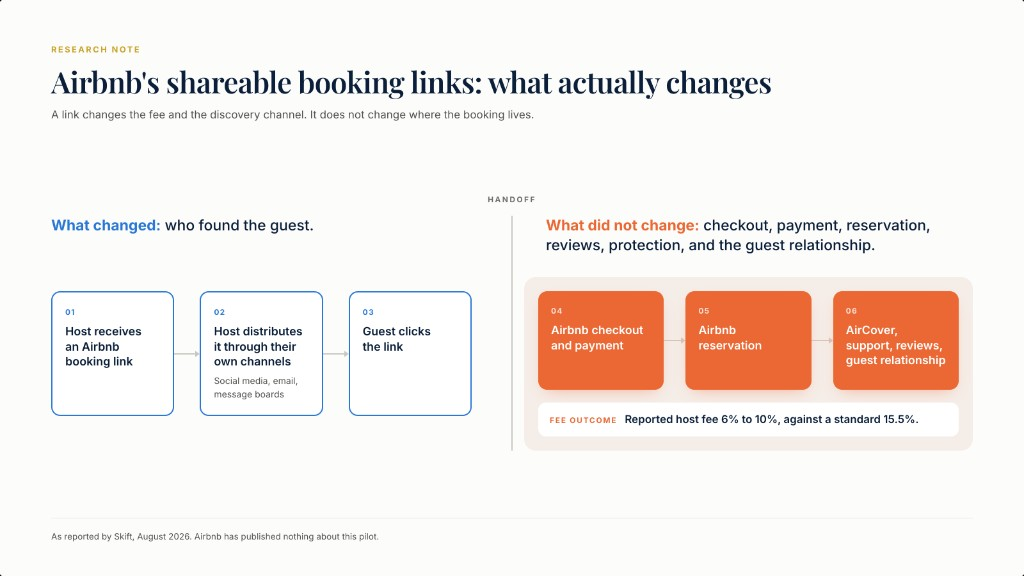
Airbnb has begun handing selected hosts a shareable booking link that carries a reduced service fee. Skift reported on August 29, 2026 that participating hosts see fees of roughly 6% to 10% instead of the 15.5% most hosts now pay, as long as the guest arrives through a link the host distributed themselves, on social media, by email, or in a forum. The booking still happens on Airbnb. Payment, messaging, reviews, and AirCover all stay exactly where they were.
Worth saying plainly before going further: Skift is the only outlet that has reported this, its sourcing is messages hosts circulated in Facebook groups and on LinkedIn, and Airbnb has published nothing about the program. Treat every detail as reported rather than confirmed.
The mechanism is small. What it concedes is not.
Airbnb just put a price on its own demand
Strip away the framing and the experiment says something Airbnb has never previously said out loud. A booking is worth 15.5% when Airbnb finds the guest. The same booking, on the same platform, with the same payment processing and the same host protection, is worth substantially less when the host finds the guest.
Everything else is held constant. The only variable is who did the work of getting a traveler to want that property.
That is not a direct booking, and calling it one muddies the interesting part — the same distinction we made when Airbnb's reported direct booking links first circulated. The guest still checks out on Airbnb, the reservation still belongs to Airbnb, and the host still cannot email that guest next spring. What Airbnb is testing is a different price for host-sourced acquisition, and in doing so it has separated two things that its commission has always bundled together: the cost of running a transaction, and the cost of producing a customer.
What the other nine points buy
The gap between 6% and 15.5% is a rough public estimate of what demand generation is worth, at least on the terms Airbnb is currently willing to offer.
Nobody should read that as Airbnb's cost structure. Pilot pricing includes strategic discounts, and a promotional rate reveals very little about underlying economics. But the direction is unmistakable, and it lines up with what Airbnb spends. The company put $2.59 billion into sales and marketing in 2025 against $12.24 billion of revenue. Booking Holdings spent $8.19 billion on marketing in the same year, close to a third of its revenue, much of it flowing to search engines and platforms it does not own.
The largest travel marketplaces in the world rent their demand. They rent it continuously, and they rent it from Google. That is the single most useful fact for any host trying to understand what their commission is actually paying for.
Direct booking is not free booking
Most direct-booking marketing stops counting one line too early.
Take a $1,000 reservation. Airbnb's standard host fee is $155. Under the reported pilot rates it would be $60 or $100. Processing that same $1,000 through Stripe at its published U.S. rate of 2.9% plus 30 cents costs $29.30.
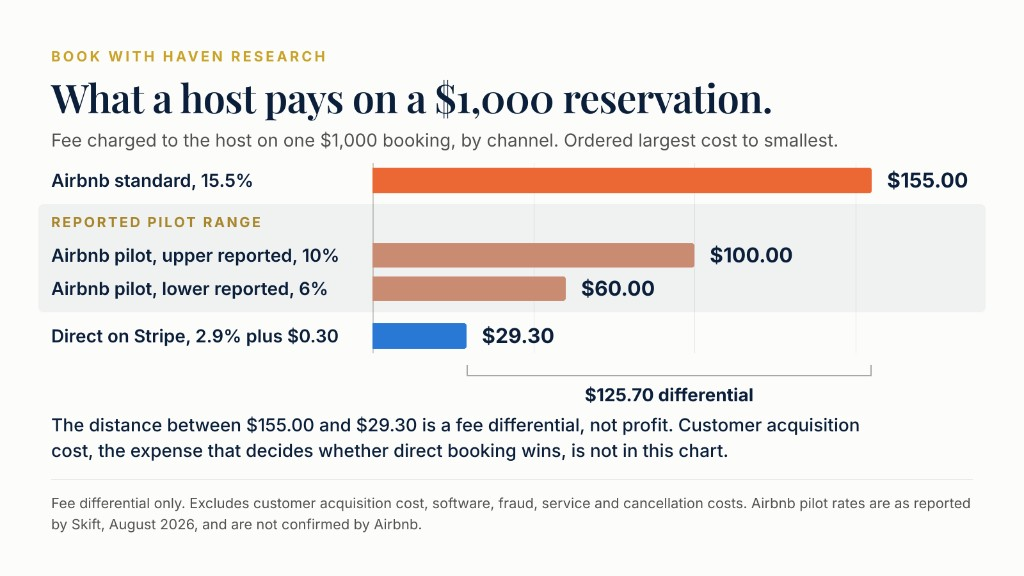
So the raw fee differential against 15.5% is about $126. That number is real, and it is also incomplete, because it accounts for exactly one line item. A direct booking still carries software cost, fraud exposure, cancellation handling, customer service, and, above all, the cost of acquiring the guest in the first place. The honest version of the equation looks like this:
avoided commission − payment cost − acquisition cost − software − servicing and risk
Two of those terms are knowable in advance. The other three are where the argument is actually won or lost. Anyone selling you "commission-free" without mentioning customer acquisition cost is selling you the first term and hoping you never calculate the third.
There is one more constraint that rarely gets mentioned. Airbnb's off-platform policy prohibits using guest contact information for marketing lists. A host cannot convert Airbnb's audience into an owned one. Owned demand has to be built independently, from scratch, with consent.
The open web grew new front doors
While all of this was happening, the plumbing for reaching travelers outside an OTA got quietly better.
Google Vacation Rentals now surfaces properties across Search, Maps, and Google Travel, and its free booking links send travelers to the partner's own site to complete the reservation. Google's own documentation is direct about the cost: there are no fees for Google-generated referrals or bookings. That is a real distribution channel that charges nothing per transaction.
It is also gated. The structured data behind it is limited to sites that have connected with a Google technical account manager and hold Hotel Center access, administered as an early adopters program. Adding markup to a property page does nothing on its own. Getting into that channel requires feed connectivity, live rates and availability, and a technical relationship most individual hosts will never have. Which is precisely why the opportunity is a platform-shaped one.
AI moved faster than the infrastructure did. Phocuswright found 56% of active U.S. travelers had used AI for at least one trip in the preceding year, up from 33% eighteen months earlier. Notably, travelers using AI inside search engines still click through to source websites about half the time, which undercuts the assumption that AI answers end the journey.
And AI has started transacting. On August 27, 2026, Google launched hotel booking inside AI Mode. Look at who got in first: Booking.com, Expedia, Marriott, Hilton, IHG, Priceline, and six other names of similar size. Not independent suppliers.
The inconvenient number
Every argument above points one direction. This one points the other, and any honest piece has to put it near the front rather than the footnotes.
In Key Data's panel of professionally managed U.S. properties, Airbnb took 50% of reservations in the first quarter of 2026, up from 46% a year earlier. Direct bookings fell to 23% from 26%.
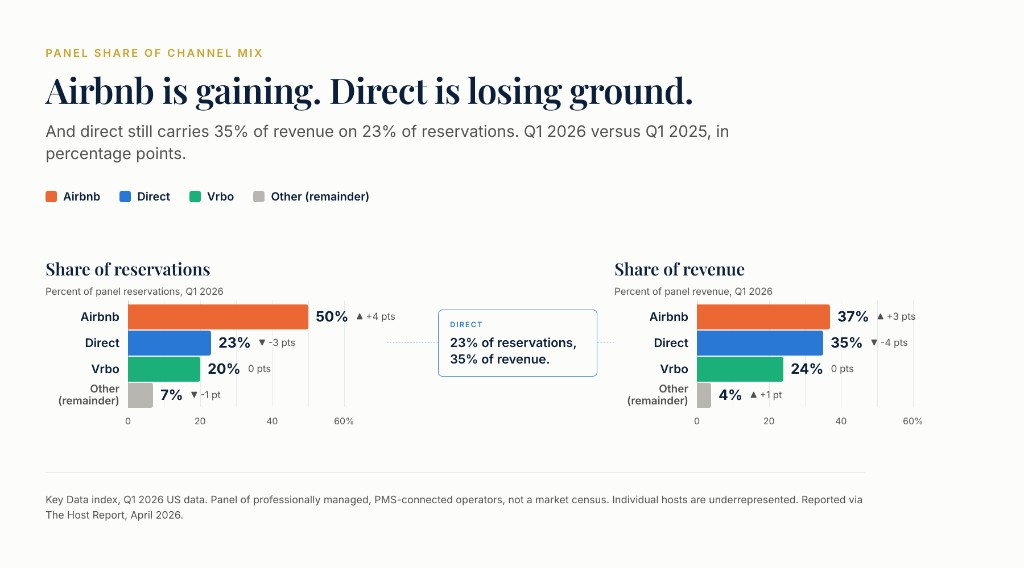
Among operators with the software, the sophistication, and the incentive to run a direct channel, direct booking lost ground to Airbnb over the past year. The infrastructure for open-web booking is improving at exactly the moment Airbnb is consolidating share of actual reservations.
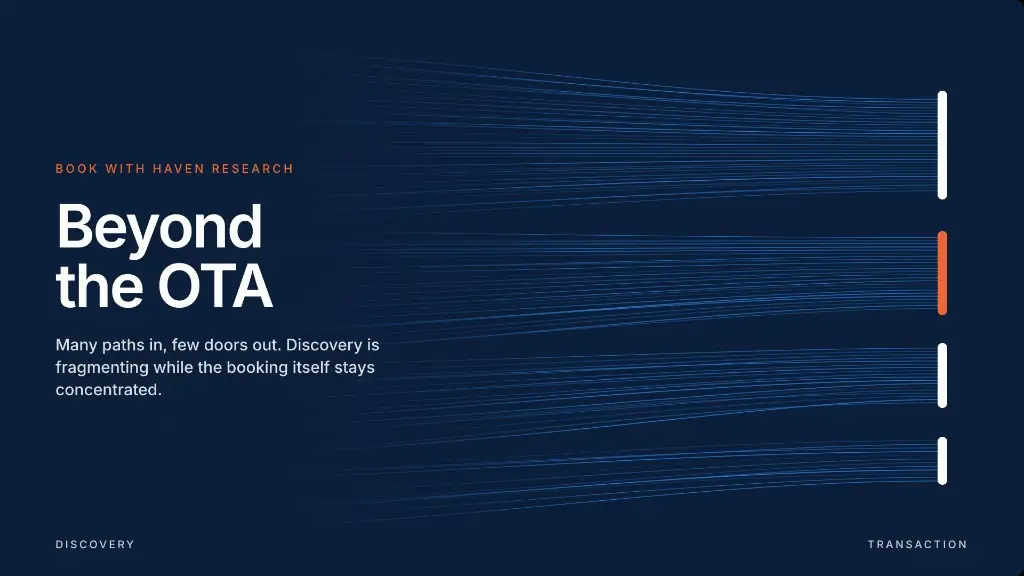
Both things are true at once, and the tension between them is the real story. Discovery is fragmenting. Distribution has not followed yet.
One detail in the same dataset is worth holding onto: direct accounted for 23% of reservations but 35% of revenue. When operators can win a direct booking, it tends to be a more valuable one.
What would actually have to be true
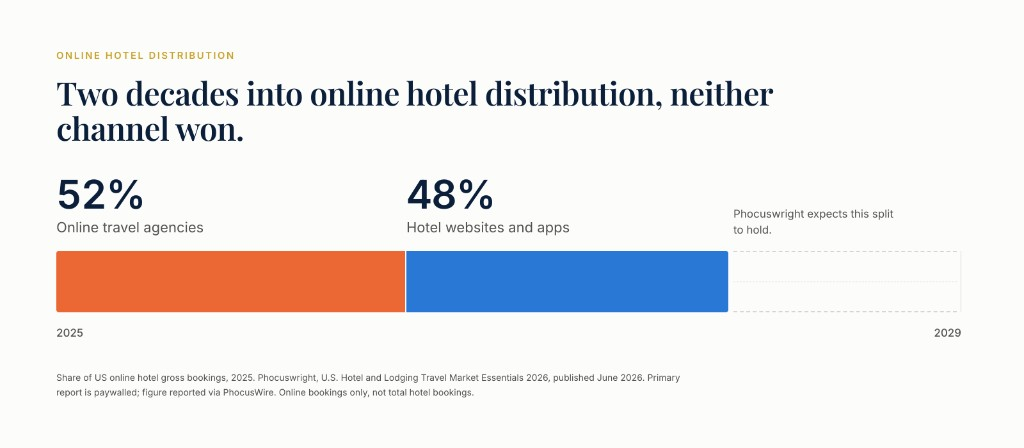
Hotels suggest where this lands. Phocuswright puts the 2025 split of U.S. online hotel bookings at roughly 52% OTA and 48% supplier-direct, and expects it to hold through 2029. Decades into online travel, both channels are enormous. That is coexistence, not displacement, and it is a more plausible destination for short-term rentals than any disruption narrative.
Getting there requires more than a booking page. A property has to be findable by machines, bookable in real time, credible to a traveler who has never heard of it, and reachable again after the first stay. That means canonical property identity, live rates and availability, Google connectivity, portable reputation, real attribution, and a guest relationship the host actually owns.
Checkout is the easy layer. Building demand is the hard one, and it is the only layer that makes the rest of the argument true.
That is the problem Haven is being built to solve, and we would rather be honest about its difficulty than pretend it is already solved. Airbnb's experiment did not prove hosts can escape the OTA. It proved that even Airbnb now prices the difference between finding a guest and processing one.
This post summarizes a longer research project. The full report covers OTA commission structures, direct-booking economics, Google and AI travel distribution, the ecommerce analogy, occupancy methodology, the strongest arguments against our own thesis, and a complete source library with 51 verified citations. Read the full research report.