Airbnb Direct Booking Links: What Hosts Need to Know

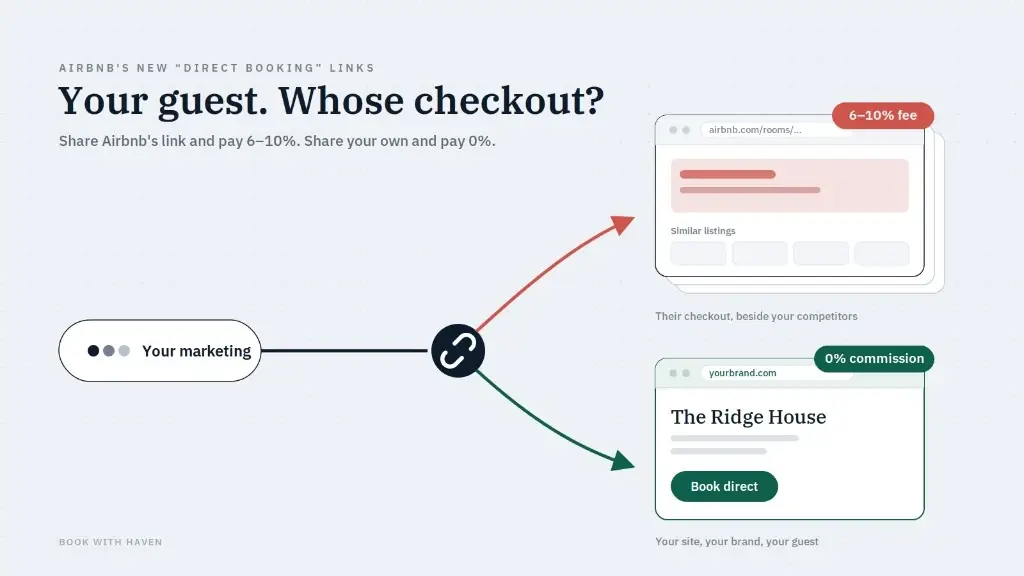
On the heels of raising its host fee to 15.5%, Airbnb is testing a new way for hosts to bring their own guests to the platform in exchange for a "discounted" fee of 6% to 10%. Notice the order of operations. Airbnb spent the past year moving hosts from a roughly 3% fee to 15.5%, and only then introduced a feature that lets them earn part of it back. In our view, that sequence is the point: the increase is what makes the discount possible. A 6% fee cannot be sold as a deal to a host paying 3%. It can to a host paying 15.5%.
So this pilot deserves a careful look. Despite the name, it is not direct booking in the traditional sense, and 6% to 10% is still a substantial price to pay when the host found the guest.
Airbnb appears to be quietly testing the feature with selected hosts under the label "direct booking links."
The pitch is straightforward. Airbnb gives participating hosts a special link to their listing. The host shares that link through social media or other marketing channels, and if a guest uses it to book, Airbnb reduces the host's service fee.
One version posted by a host in Airbnb's own Community forum lowers the fee to 6%. The screenshot that prompted this article, shared publicly by a host on Facebook, offers a 10% rate. Airbnb has not published documentation explaining why different hosts appear to be receiving different percentages.
The pilot message makes several things clear: these are still Airbnb reservations, they retain the benefits associated with booking through Airbnb, including AirCover for Hosts, and the reduced fee only applies to new reservations initiated through the special link. Airbnb also suggests hosts can share the savings with guests, presumably through lower pricing. The company describes the feature as a pilot that it may modify or discontinue.
That makes this more than a minor pricing experiment.
Airbnb is putting a different price on a reservation the host acquired versus one Airbnb acquired through its marketplace. That distinction has important implications for anyone building a direct booking strategy, and so does the sequence of fee changes that led up to it.
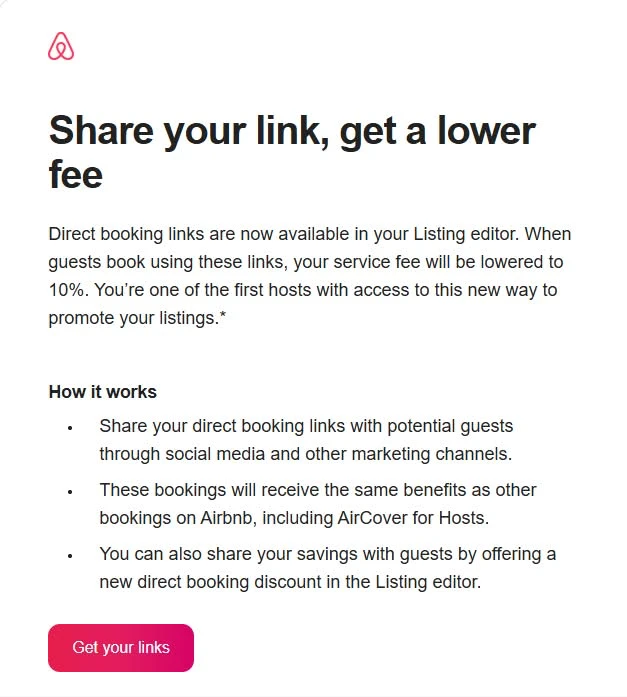
A host-shared screenshot of Airbnb's pilot message. This version offers a 10% host service fee on bookings made through the special link.
Key takeaways
- Airbnb is testing host-shared “direct booking links” that, according to participating hosts, reduce the host service fee to about 6%–10%.
- These are not true direct bookings: checkout and the reservation still occur on Airbnb.
- The host generates the traffic; Airbnb still provides checkout, support, and AirCover.
- A true direct booking happens on the host’s own website and gives the host more control over branding and the guest relationship.
- Airbnb has not published detailed documentation of the pilot, and reported fees vary among participating hosts.
What is an Airbnb "direct booking link"?
An Airbnb “direct booking link,” in this pilot, is a URL Airbnb gives a participating host to share with guests the host already acquired. When a guest books through that link, Airbnb may charge a lower host service fee. Checkout and the reservation still take place on Airbnb.
The name is likely to cause some confusion.
Traditionally, a direct booking means the guest books directly with the hospitality business rather than through an online travel agency. The guest might discover the property through Google, Instagram, an advertisement, an email, a referral, or a previous stay, then complete the reservation on the host or property manager's own website.
Airbnb's pilot works differently. The host supplies the traffic, but Airbnb still supplies the booking platform.
The path looks something like this:
Host's marketing → Airbnb direct booking link → Airbnb checkout → Airbnb reservation
Rather than:
Host's marketing → Host's website → Direct reservation
The reservation never leaves Airbnb.
Sharing Airbnb listings outside Airbnb is not new. Airbnb already lets hosts create personalized URLs for their listings specifically so they can promote them elsewhere. What is new is the economics. Airbnb is now testing whether it should charge less when the host, rather than Airbnb's marketplace, generates the customer.
Why would Airbnb charge less?
The logic is fairly easy to understand.
Airbnb normally combines several forms of value into a single service fee. It operates a massive travel marketplace where guests can discover properties, but it also provides the infrastructure surrounding the transaction: booking, payments, customer support, trust systems, and host protections.
Airbnb says most hosts on its single-fee structure currently pay 15.5%, while others generally pay between 14% and 16%. Listings in Brazil and Mexico pay 16%, according to Hostaway. That single fee is becoming universal. Airbnb began migrating software-connected hosts to the host-only model in late 2025, and in July 2026 it announced final deadlines for everyone else — September 15, 2026 outside the European Economic Area, and October 13, 2026 in the EEA and Switzerland.
Now consider a reservation generated through one of these new links.
The guest did not discover the property while browsing Airbnb. Perhaps the host:
- paid for the Google or Meta ad;
- built the Instagram audience;
- ranked their property in organic search;
- cultivated an email list;
- earned a referral;
- created a recognizable local brand; or
- convinced a previous guest to return.
In each case, much of the customer-acquisition work has shifted from Airbnb to the host. Airbnb still provides value after the click, but it did not create the demand.
Seen through that lens, reducing the service fee makes economic sense. What deserves a closer look is when this offer arrived, and what fee it is being measured against.
The timing looks planned, not generous
Here is our honest read of this pilot, and it starts with a piece of recent history.
What we know
Until late 2025, most hosts paid Airbnb roughly 3% per booking under the split-fee model, with guests paying a separate service fee of about 14% to 16% at checkout. Airbnb then spent a year dismantling that structure. Software-connected hosts were moved to a single 15.5% host-only fee starting October 27, 2025, remaining software-connected hosts followed on April 13, 2026, and the final migration deadlines for self-managed hosts land in September and October 2026.
Then, with the fee consolidation nearly complete, a pilot appears that offers hosts a "reduced" rate of 6% or 10% on bookings they generate themselves.
Haven's analysis
We believe the sequence is deliberate. A discount is only as impressive as the number it is measured against, and Airbnb spent a full year installing that number. In our analysis, this is anchor pricing, executed at platform scale.
Run the math from the host's side and the discount inverts. A host who shared their Airbnb listing link in early 2025 and landed a booking paid about 3% on it. That same self-generated booking through today's pilot costs 6% at the favorable rate, double the old fee, or 10% at the rate in the screenshot that prompted this article, more than triple. The bookings being "discounted" are precisely the ones that got the largest increase.
To be fair to the counterargument: under the old model, guests also paid their fee on those bookings, and Airbnb's total take across both sides was higher than 6%. Airbnb has framed the single fee as a simplification that lets guests see the full price upfront. Both things can be true. The structure can be simpler for guests and still function, for hosts, as a price increase followed by a partial refund presented as a favor.
Hosts evaluating this pilot should judge the fee against what their own marketing is worth, not against a baseline Airbnb chose for them.
How hosts are reacting
The pilot surfaced through hosting communities rather than an Airbnb announcement, and the reaction across several large Facebook hosting groups is worth reading closely, because it splits into two distinct currents: confusion about what the feature is, and suspicion about why it exists.
Start with the confusion. Several hosts initially read the offer as Airbnb charging 10% on reservations made through their own websites, and asked, reasonably, why anyone would hand Airbnb a cut of bookings it currently collects nothing from. Other members had to step in and clarify that the link points to the host's Airbnb listing, not to a direct booking site. When a feature's own target audience cannot tell what it does, the name is doing the misleading.
The suspicion ran deeper. The most-liked comment in one thread warned that there is a catch, that "they are getting you to do their marketing for them," and advised sharing your own direct booking link instead and paying no fee at all. In another group, a host framed the same point as advertising: hosts who share these links are promoting Airbnb at their own expense, doing demand-generation work the platform once did for itself, and receiving a fee reduction rather than payment for it. A third put it more dryly, observing that the guest could have booked with the host directly, and that for the privilege of routing them through Airbnb anyway, the platform will generously charge a lower percentage.
Others read the pilot as an attempt to pull reservations back from hosts' direct sites onto Airbnb. Several announced that the only link they intend to share is their own. One thought even the reduced rate should be lower. And at least one host floated her own theory about the 15.5% increase itself, connecting it to Airbnb's ambitions to bring hotels onto the platform.
The theories vary. The instinct behind them does not. Hosts sense that the arithmetic of this offer was worked out in Airbnb's favor, and notably, the most active voices in these threads were not debating whether to take the deal. They were explaining it to each other, and then declining it.
6% to 10% is lower. It is not small.
A reduction from 15.5% to 10%, or especially to 6%, is meaningful. Hosts offered the pilot get better economics than they would by sending the same guest through a normal Airbnb booking path.
But percentages can obscure the amount of money involved.
| Booking value | 6% fee | 10% fee | 15.5% fee |
|---|---|---|---|
| $1,000 | $60 | $100 | $155 |
| $2,500 | $150 | $250 | $387.50 |
| $5,000 | $300 | $500 | $775 |
| $10,000 | $600 | $1,000 | $1,550 |
On a $5,000 reservation, even the lower 6% rate represents $300. At 10%, it is $500.
Those numbers are easier to justify when Airbnb introduced the guest to the property. Airbnb operates an enormous marketplace, and customer acquisition has real value.
The calculation changes considerably when the host generated the reservation. If you paid to acquire the click, built the audience that produced it, or spent years developing a brand that brought the guest back, paying hundreds of dollars to an OTA simply to finish the transaction deserves closer scrutiny.
What does the host get for that fee?
The comparison needs to remain fair. The reduced fee is not payment for nothing.
According to the pilot message, these reservations continue to receive the benefits of ordinary Airbnb bookings, including AirCover for Hosts. Airbnb says AirCover for Hosts includes guest identity verification, reservation screening, up to $3 million in Host damage protection, $1 million in Host liability insurance, and a 24-hour safety line, subject to the program's terms, conditions, and exclusions.
Airbnb also handles the booking flow and provides customer-support infrastructure. Airbnb itself says service fees help cover services such as its 24/7 customer support.
For some hosts, that package may make 6% an attractive trade. It is still not equivalent to a true direct booking, and the reasons go beyond the fee.
Your marketing, Airbnb's storefront
Follow the guest's journey through one of these links and the problem comes into focus.
The host pays for the ad, writes the Instagram post, or earns the referral. The guest clicks. And they land on Airbnb: Airbnb's header, Airbnb's search bar, Airbnb's map, and, most importantly, Airbnb's recommendation modules. The listing page surrounds the host's property with similar listings, comparable stays nearby, and an open invitation to keep browsing.
The host has, at their own expense, delivered a warm, travel-ready shopper into a marketplace stocked with every competitor in their market. If the guest wanders to a neighboring listing and books it instead, the host who paid for the click gets nothing, and under the pilot's terms Airbnb presumably collects its full fee on the competitor's booking. The host's marketing budget becomes Airbnb's top-of-funnel.
Branding suffers the same fate. There is no host logo on the page, no custom domain in the address bar, no control over design, photography layout, or messaging hierarchy. The guest's memory of the transaction is that they booked an Airbnb. Whatever brand equity the host's marketing created gets deposited into Airbnb's account, not the host's.
And the relationship stays on Airbnb's terms afterward. Airbnb's Off-Platform and Fee Transparency Policy prohibits hosts from encouraging current, future, or repeat Airbnb bookings to move off the platform, and it prohibits using guest contact information for marketing communications or adding Airbnb-supplied guest details to marketing lists. The host generated the guest, paid a fee to close them, and still cannot freely market to them again. That is the guest-relationship cost we described in What Airbnb Won't Tell You About Owning the Guest Relationship.
A booking channel where you supply the demand, surrender the branding, expose the guest to competitors, and forfeit the remarketing rights is not a direct channel. It is a referral program.
Airbnb's direct link vs. a true direct booking
Place the two models side by side and the differences sharpen.
| Criterion | Airbnb "Direct Booking Link" | True Direct Booking |
|---|---|---|
| Who generated the guest? | Host | Host |
| Where does the guest book? | Airbnb | Host's website |
| Competitor listings on the page | Yes | No |
| Platform commission | Reported pilot rate of 6%–10% | Depends on provider; can be 0% |
| Payment processing | Airbnb | Host/payment processor |
| Airbnb AirCover | Yes | No |
| Booking terms | Airbnb ecosystem | Host's terms |
| Brand experience | Airbnb | Host's brand |
| Guest relationship | Subject to Airbnb policies | Directly managed by host |
| Future marketing | Restricted by Airbnb policies | Controlled by host, subject to applicable law |
The guest relationship may ultimately be the most important row. A properly operated direct booking business meets the customer on its own website from the beginning. It can collect appropriate marketing consent, understand where the customer came from, build a first-party guest database, and develop a long-term relationship outside an OTA, subject of course to applicable privacy and marketing laws.
A direct booking therefore has value beyond the commission saved on a single reservation. It makes the next reservation easier to acquire.
What the pilot quietly concedes
Airbnb's experiment separates two things that have historically been bundled together: distribution and booking infrastructure. A longer evidence review of that split — including current U.S. channel-share data and Google's no-fee vacation-rental referrals — is in Haven Research on the future of short-term rental booking beyond the OTA.
When Airbnb introduces a traveler to a property through its marketplace, distribution is a substantial part of what the host is paying for. When the host introduces the traveler to Airbnb, that portion of the equation changes. The pilot acknowledges as much, and in doing so it validates one of the central arguments behind direct booking: the ability to generate your own demand is extraordinarily valuable.
Once a host can reliably produce guests through their own website, social presence, referrals, advertising, email audience, and repeat business, the economics of paying a percentage of every reservation become increasingly difficult to ignore. The Real Cost of Airbnb Fees walks through those channel economics with worked examples.
The difference compounds. Imagine a property generating $100,000 a year from guests the host acquired independently. At 10%, that represents $10,000 in platform fees. At 6%, it is still $6,000. At 0% commission, that money remains with the hospitality business, aside from normal expenses such as card processing and whatever software or protection products the operator chooses to use.
At scale, that changes what the business keeps.
There is still a strong case for Airbnb
None of this means hosts should abandon Airbnb. For many operators, that would be counterproductive.
Airbnb remains one of the most powerful demand-generation engines in travel. A traveler who has never heard of your property can search a destination, discover it, evaluate reviews, and make a reservation in minutes. That reach is valuable.
The better long-term strategy for many hosts is not Airbnb or direct booking. It is Airbnb and direct booking, with each channel doing the job it is best suited to do. Let marketplaces introduce new travelers to your property. At the same time, build a brand capable of generating its own demand. The stronger that independent channel becomes, the less dependent the business becomes on paying another company for every reservation it receives.
Where Haven fits
This distinction is a major reason we built Haven.
Haven gives vacation-rental hosts and property managers a branded booking channel on their own domain. Unlike an OTA, Haven does not take a percentage of each direct reservation. Current paid plans include 0% Haven booking commission, with standard payment-processing costs applying separately. Our guide to direct bookings covers how that channel sits alongside Airbnb and Vrbo.
The objective is not to replace every OTA reservation. It is to give hosts somewhere better to send the guests they already generate.
A guest coming from your Google ad, Instagram profile, email campaign, local partnership, referral, or repeat stay can book through a site carrying your brand, with no competitor carousel underneath your photos, rather than being returned to a marketplace where the transaction stays inside someone else's ecosystem.
Haven also combines that booking experience with tools intended to make the direct channel more useful over time, including guest CRM, marketing tools, guidebooks, screening options, and branded guest experiences.
There are still costs associated with accepting a direct reservation. Card processing is not free. Hosts need appropriate insurance and protection, sensible cancellation policies, fraud controls, and operational systems. But those are fundamentally different economics from surrendering 6% or 10% of gross booking value on every reservation you generated yourself.
Should hosts use Airbnb's new links?
If you have access to the pilot, there are situations where the answer is clearly yes.
If a guest specifically wants to book through Airbnb, using a qualifying lower-fee link instead of sending them through your ordinary Airbnb listing is plainly advantageous. For a host without serious direct booking infrastructure yet, it may also provide a workable middle ground: market the property yourself while Airbnb handles the reservation.
But if you already operate a capable direct booking site, the question is different. You are deciding whether a guest you acquired should be sent to Airbnb, where the pilot may charge 6% to 10% of the reservation, place your listing beside your competitors, and keep the guest relationship inside Airbnb's policies, or to your own booking channel, where you control the brand and the customer relationship and can potentially pay no booking commission at all.
That is a much harder case for Airbnb to win.
The bigger signal
Airbnb's direct booking pilot is interesting not because Airbnb has suddenly embraced direct booking. It has not. The booking still happens on Airbnb, on Airbnb's page, under Airbnb's brand, next to Airbnb's other listings.
What Airbnb appears to be recognizing is that a customer the host acquires is worth treating differently from a customer the marketplace acquires. That distinction should matter just as much to hosts, and so should the pricing history behind the offer. A 6% fee reads as generous only against the 15.5% baseline that arrived months earlier.
Airbnb can remain an excellent place to find new guests. But the guests your own business finds are different. You built the audience. You earned the referral. You paid for the advertisement. You created the brand that made someone return.
Paying Airbnb 6% instead of 15.5% is an improvement. Building a booking channel you actually own is better still.
Sources
- Rental Scale-Up — Airbnb Host Fees of 15.5% is coming for all hosts
- Hostfully — Airbnb Host Fees: The 15.5% Host-Only Fee Explained
- Hostaway — Airbnb Host-Only Fee Explained
- TabiVista — Airbnb Host Service Fee Percentage 2026
- Airbnb — Q3 2025 shareholder letter (SEC Form 8-K exhibit)
- Airbnb Help Center — Airbnb service fees
- Airbnb — AirCover for Hosts
- Airbnb Help Center — Off-Platform and Fee Transparency Policy
- Host-shared Airbnb pilot message offering a 10% host service fee, posted publicly in a Facebook hosting group (screenshot above). A 6% variant was reported in Airbnb's Community forum. Airbnb has not published documentation of the feature.
- Comment threads in two Facebook hosting groups, paraphrased without names, for the reaction section.