Maybe the Sanctuary Is the Forest
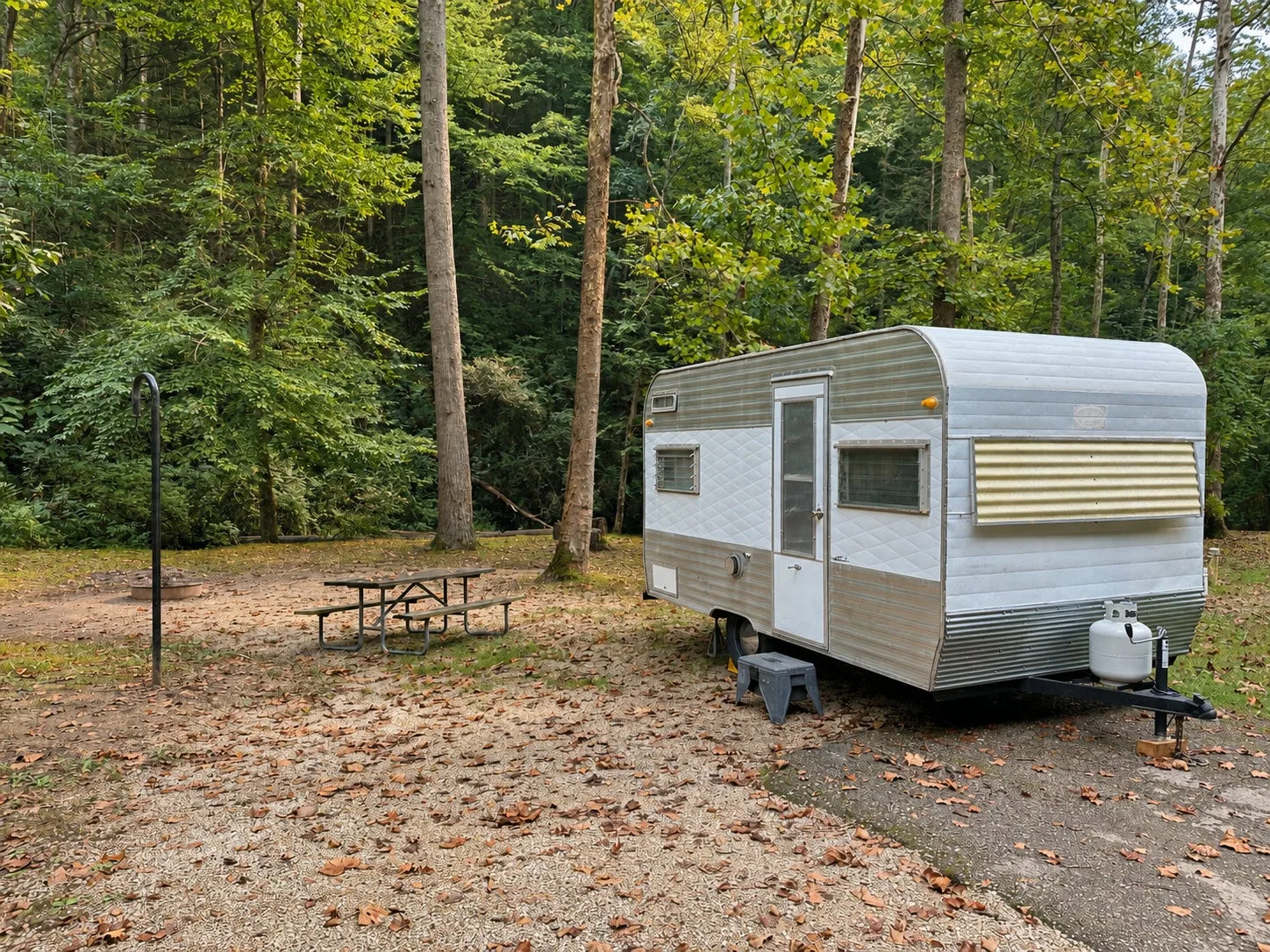
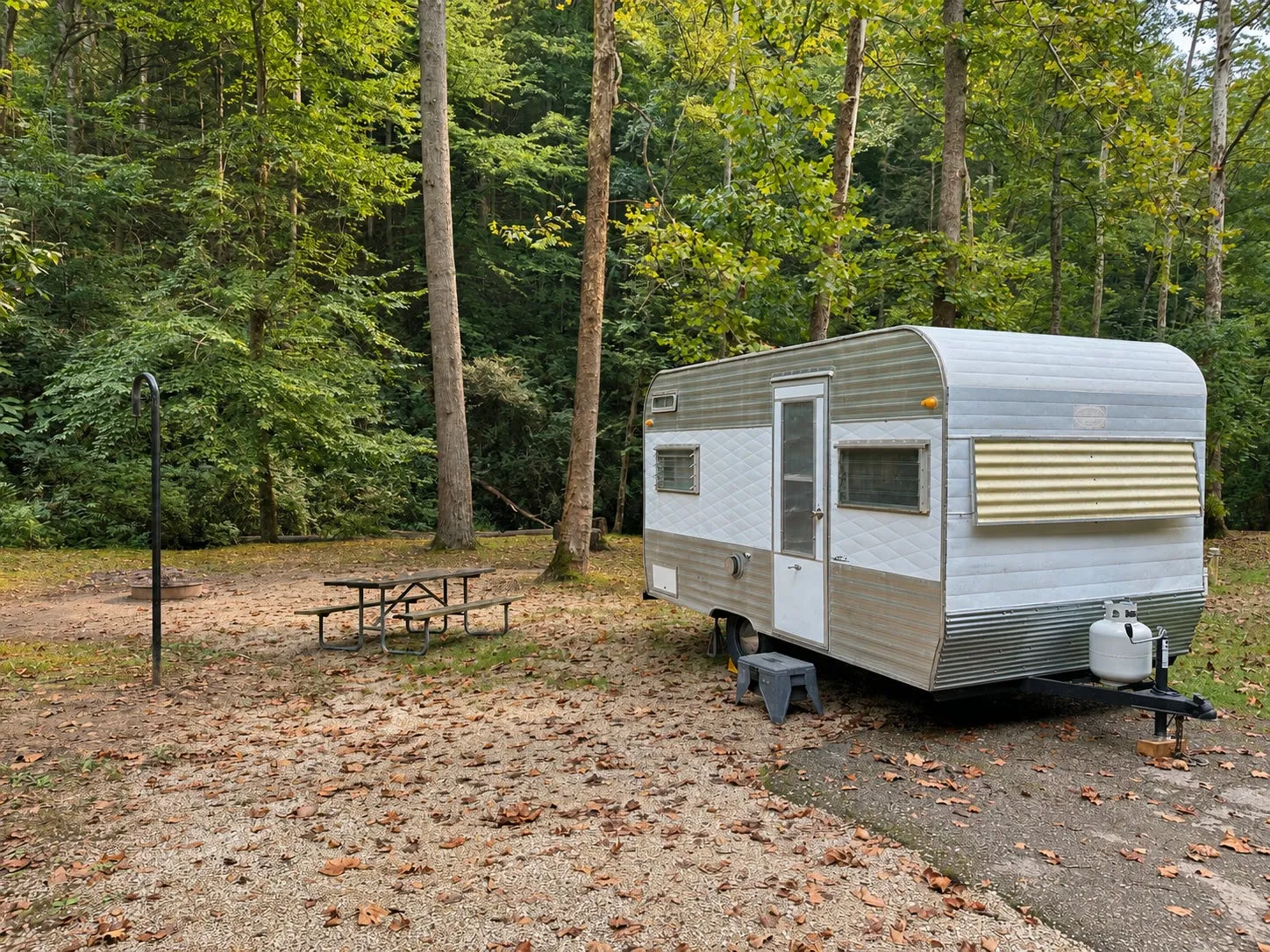
Sylvie at Whittleton Campground, one of many beautiful State Campgrounds in the area with free HOT Showers for the the guests.
I came to Red River Gorge looking for properties to include in Sanctuary Found, but after spending a week here, I began to wonder whether I had been looking in the wrong direction. The Gorge is full of short-term rentals designed to photograph beautifully: luxury cabins, domes and treehouses tucked into the forest or stacked neatly along ridges, usually with soaring windows, polished modern interiors, air conditioning, Wi-Fi and, almost inevitably, a jacuzzi. Some fetch upwards of $500 a night. They are exactly the kind of properties that perform extraordinarily well in an Airbnb search or Instagram feed, where dramatic architecture against an equally dramatic landscape is often enough to sell the experience.
I reached out to a number of smaller rentals and guest houses while I was here because I wanted to talk with owners about restorative hospitality and the Sanctuary Found collection. Most of that outreach went unanswered. As the week went on, I became less disappointed by that because I started realizing that the lodging most aligned with what I am trying to create may already exist here in abundance, just in a much less glamorous form. It is the campgrounds.
There are public state and privately operated campgrounds throughout the Red River Gorge area, from developed sites with electricity and showers to primitive camps offering little more than enough level ground to park or pitch a tent. Google Maps reveals campground after campground throughout the Gorge, while platforms such as Hipcamp open another layer of privately owned land, small operations and individual campsites that a traveler passing through might otherwise never discover. After staying in both established campground sites and on private land through Hipcamp, I kept coming back to the same thought: sometimes the absence of amenities becomes the amenity because there is less standing between you and the place you came to experience.
I have already written about why I don’t consider the ubiquitous chemically treated jacuzzi a wellness amenity, so I won’t repeat that argument here. What interested me more in Red River Gorge was the larger contradiction in modern nature tourism. We travel hundreds or thousands of miles to reach extraordinary natural landscapes, then pay hundreds of dollars a night to recreate the same controlled environment we left home to escape. We seal ourselves inside, turn on the air conditioning, stabilize the temperature, connect to Wi-Fi, watch television and experience the forest primarily as a composition framed through glass. The architecture may be spectacular, but the landscape slowly becomes décor.
Red River Gorge seems to ask for something different. Its sandstone cliffs, natural bridges, enormous rock formations, dense hardwood forests, creeks and trails continually pull attention outward. This is a place where the destination is already providing the experience. Hospitality does not need to compete with it; it may simply need to give us somewhere comfortable enough to sleep while allowing the Gorge to do the rest.
Give the Gorge at Least Three Days
There is a reel that keeps finding me in my algorithm in which Zach Bush talks about what happens when people spend several uninterrupted nights outside. In his [recent conversation with Joe Rogan](http://Joe Rogan Experience #2529 — Zach Bush on Apple Podcasts), he describes a three-day period in nature as a profound biological reset, talking about immune activity, T cells and stem-cell signaling as the body reconnects with a living environment. What interests me most is the larger idea beneath those individual mechanisms: what changes when nature stops being somewhere we visit and becomes the environment our body is actually living in again?
Modern wellness has become remarkably good at manufacturing isolated pieces of nature indoors. We install circadian lighting systems because changing light affects human physiology. We buy sunrise lamps because we do not see sunrise. We use blackout curtains because our nights are filled with artificial light. We run air purifiers because breathing clean air matters. We build cold plunges and saunas because temperature changes affect us. We manufacture nature soundtracks, install living walls, diffuse plant extracts and spend enormous amounts of money creating interiors intended to calm the nervous system. There can be value in many of those interventions, particularly when access to nature is limited, but the forest is already doing all of those things at the same time.
Outside, light changes continuously throughout the day. Temperature rises and falls. Humidity shifts. Wind moves across the skin. Rain changes the soundscape. Birds, insects, water and leaves create irregular acoustic environments. Our eyes continually move between objects a few inches away and landscapes extending for miles. We walk over uneven surfaces instead of perfectly flat floors, breathe compounds released by living plants, touch soil, encounter microorganisms and experience actual darkness after sunset. None of those things occurs independently, which may be part of why sustained immersion feels so different from adding a single “wellness” intervention to an otherwise conventional indoor environment.
One of the most interesting areas of forest-bathing research involves the autonomic nervous system. Studies of shinrin-yoku, the Japanese practice commonly translated as forest bathing, have reported reductions in physiological measures of stress and changes in heart-rate variability consistent with greater parasympathetic activity. That matters enormously to how I think about restorative hospitality because we often describe an environment as restorative simply because it looks peaceful. We use soft colors, beautiful bedding, natural materials and uncluttered rooms and then assume the person occupying the space must therefore be relaxing. I am much more interested in whether the body actually begins behaving differently there.
The nervous system is continuously reading its environment. Light, sound, temperature, visual complexity, smell, movement, other people and our perception of safety are all part of that information. A forest is extremely complex, but it is a kind of complexity humans have been surrounded by throughout most of our existence. That is fundamentally different from the complexity of notifications, traffic, artificial lighting, screens, mechanical noise and the constant demand for directed attention. Research on forest exposure has reported decreases in cortisol and other stress-related measures, along with shifts in autonomic activity. The science continues to develop, but the larger pattern is increasingly difficult to ignore: our physiology responds to where we are.
The forest is also chemical. Trees are not simply scenery; they are living organisms releasing compounds into the environment around them. Among those compounds are naturally occurring volatile substances frequently described as phytoncides. Researchers studying forest bathing have investigated whether inhaling these tree-derived compounds may contribute to some of the immune changes observed following forest exposure. Natural killer cells, or NK cells, have received particular attention. They are part of the immune system’s surveillance network, and forest-bathing studies have reported increases in NK-cell activity and changes in proteins associated with their normal immune function following time spent in forest environments. Some multi-day studies have even found that these changes remained measurable after participants returned home.
What fascinates me is not the idea that there is one magical substance floating between the trees. It is the recognition that when we enter a forest, we enter into biological exchange with it. We are not simply looking at trees; we are breathing what they release. The exchange extends beyond plant chemistry as well. Soil, plants, water and outdoor air contain enormously diverse microbial communities, and research into environmental biodiversity and the human microbiome is increasingly interested in what happens when humans living largely sanitized indoor lives regain regular contact with biologically diverse environments. That does not mean sitting in the dirt is a prescription for fixing the microbiome, but it does suggest something more fundamental: the human body is not biologically separate from the ecosystem surrounding it.
Allove and I certainly spent enough time in direct contact with this one. We came into Kentucky after traveling through Missouri, where ticks had become a regular nuisance. I expected the Gorge to be much the same, but my experience was completely different. We spent days on primitive sites, sat directly on the ground, walked through the woods and lived almost entirely outside, and I did not pull a single tick from either of us. That is not to say ticks are not present in Red River Gorge, because they absolutely can be and anyone hiking or camping should still check themselves and their animals. They simply were not a nuisance during my stay in the way they had been immediately beforehand in Missouri. We picked up a few bites from mosquitoes or whatever other insects decided to dine on us, but remarkably few considering how much time we spent outdoors, and that small difference made extended outdoor living feel incredibly easy.
Some of the most compelling research on camping has little to do with forests specifically and almost everything to do with light. Researchers studying circadian rhythms have found that when people leave modern electrical lighting behind and spend time camping under natural daylight and darkness, their internal timing begins shifting toward the solar day. Melatonin timing moves earlier, and biological night becomes more closely aligned with sunset and sunrise. Later research found that even a weekend of camping under natural light could measurably shift circadian timing.
That becomes especially interesting when viewed against the way we now build wellness environments. We spend considerable money trying to reproduce natural lighting inside buildings because we have begun to understand that the timing and spectrum of light matter, yet one of the simplest ways to experience an appropriate light-dark cycle is simply to live outside for a few days. Morning gets bright, evening gets dark, temperature changes naturally and the body receives environmental information that even the most sophisticated interior lighting system can only imitate.
That was one of the things I loved about traveling with Sylvie, my little 1966 camper. She gave me enough shelter to have a bed, stay dry and feel secure without removing me from the environment around me. Her shutter windows stayed open the entire time I was in the Gorge, so there was never a sealed wall between me and the forest. Air moved through the trailer throughout the day and night, rain was audible on the roof, temperature shifted naturally, insects and birds remained part of the soundscape, and morning light reached me through the open windows. When I woke up, I did not have to leave a conditioned interior to go experience nature. I was already in it.
The forest was not somewhere I had to drive to after breakfast. It was five feet away.
There is also a growing body of research around nature and cognition. Modern life requires enormous amounts of directed attention as we move continually between screens, emails, messages, navigation, decisions, work, news and entertainment while the brain simultaneously filters everything deemed irrelevant. Natural environments appear to ask for our attention differently. Attention Restoration Theory proposes that nature engages a softer form of fascination that allows heavily used directed-attention systems an opportunity to recover, and research has explored improvements in attention, working memory and cognitive flexibility following exposure to natural environments, although results vary by study and by the cognitive functions being measured.
Then there is the frequently cited wilderness study in which participants spending several days backpacking in nature without electronics performed approximately 50 percent better on a creative problem-solving task after four days. The researchers could not completely separate the effect of being in nature from the effect of disconnecting from technology, but from the perspective of restorative travel I am not sure we need to. Camping gives us both.
My own experience in Red River Gorge was not a technology detox, and I was actually grateful for that. Both the private Hipcamp property where I stayed and the campground sites I used had cell service. This trip was not a vacation from my life; this is my life. I had meetings, emails and work to do on Sanctuary Found, and being connected allowed me to remain in nature longer rather than forcing me to choose between working and being there. I could work for several hours, close the computer and immediately be back under the trees.
For someone traveling specifically to restore, however, I would recommend taking the experiment further. Turn the phone off when you can, stop consuming news, leave television somewhere else and give yourself enough uninterrupted time for boredom to arrive and then notice what happens after it does. This overlaps closely with what I think of as a Nature Fast. A Nature Fast is not simply a fast from food; it can also be a temporary fast from media, constant conversation, artificial environments, overconsumption, schedules and the steady stream of inputs our systems are required to process. We remove enough stimulation to find out what becomes available in its absence.
The Fire Is Part of the Experience
One unexpected luxury of camping here was being able to have a campfire. Back home, summer is wildfire season, and the danger can make fire restrictions a normal part of spending time outside. There are stretches of the year when building a fire simply is not worth the risk, even when it is technically permitted. Here, I was reminded how much the fire itself changes the experience of camping. Kentucky can also restrict fires when forest-fire danger becomes extreme, and state-park rules require fires to remain in designated areas and be attended, but during my stay a fire could actually be part of the evening.
That turns out to be more than nostalgia. Anthropologist Christopher Dana Lynn studied 226 adults across a series of experiments examining responses to simulated hearth fires. Participants exposed to an audiovisual fire—the flickering light together with the sound—showed consistent reductions in blood pressure, with the relaxation effect becoming stronger with longer exposure. Lynn describes fire as a multisensory experience and explores the possibility that the hearth became important not only because it supplied warmth, light, protection and cooked food, but because it also created a social center around which humans could relax together.
It is hard not to recognize that dynamic when you actually sit around one. Fire changes the pace of an evening. There is something to watch that is continually changing but asks nothing from you. The light is warm and irregular rather than electrically constant. There is the crackle of wood, the shifting heat and the smell of smoke. People tend to pull their chairs into a circle without anybody instructing them to do so, and once they are there, conversation has somewhere to unfold.
That was exactly what happened with the guys camping near me. They began as strangers, we started talking, and eventually we were sitting together around the fire. By the time I left, they felt like friends. Nobody programmed that experience. There was no scheduled mixer or facilitated community-building exercise. We were simply human beings outside, with a fire burning and nowhere particularly urgent to go.
This may be one of the most overlooked aspects of primitive campgrounds as restorative places. They naturally lend themselves to family and connection because guests have to participate in living there. Someone makes the fire, someone cooks, kids explore, people walk past neighboring sites and somebody inevitably needs something another camper happens to have. Chairs migrate toward whichever fire is still burning after dark, meals take longer because there is no television waiting inside, and conversation happens because the environment leaves room for it.
A luxury property can spend hundreds of thousands of dollars designing a communal space and still struggle to manufacture something that a circle of chairs around a simple campfire accomplishes almost effortlessly.
There Is Also Sleep
Sleep is another part of the equation. The combination of natural light, more movement, cooler nighttime temperatures, darkness and reduced evening stimulation may help explain why camping can feel so different to the body. Sleep is one of the foundations of the entire Sanctuary Found philosophy because restoration cannot happen if an environment continually interferes with it.
We often attempt to engineer sleep through better mattresses, blackout shades, sound machines and temperature controls. Those can all be useful, but extended camping removes some of the disturbances upstream. The day contains more movement, morning contains more light, night contains less artificial illumination, and our schedule begins responding more closely to the environment rather than the clock. With Sylvie’s windows open, even the transition from day to night was something I experienced rather than something the trailer insulated me from.
Not everything important about nature, however, needs to be reduced to cortisol, heart-rate variability or immune cells. There is also awe, and Red River Gorge supplies it constantly. An ordinary trail suddenly opens beneath a massive sandstone arch. Cliffs appear through trees. A rock formation makes a human being look tiny. Mist moves across the forest, and after rain the whole landscape seems to become more saturated. Research into nature exposure has also examined social connection and prosocial behavior, with awe and perceived beauty among the possible pathways connecting natural environments with changes in how people relate to one another.
My Hipcamp host understood that balance particularly well. He was responsive and available without inserting himself into the experience, which is exactly the kind of stewardship I look for in restorative hospitality. There was space for me to choose where I wanted to camp, space to work, space to disappear into the woods and room for Allove to roam off leash. She loved it. We have not entirely managed to explain to her that a dog her size can essentially become eagle bait, although I did not see signs around our camp of predators particularly interested in eating her. She wandered, sniffed, slept in the grass and seemed to settle into outdoor life even more quickly than I did.
Watching an animal live outside is another reminder of how much modern human life has become separated from the environment our bodies developed within. We are animals too, though our buildings sometimes make that very easy to forget.
Maybe We Have Overdesigned Restoration
I say all of this as someone who loves design. My professional life has been shaped by construction, interiors, buildings and a continuing fascination with how environments affect the people occupying them. I am not arguing against beautiful architecture in nature, nor do I think everyone needs to sleep in a tent to restore. I am increasingly convinced, however, that restorative design requires knowing when to stop designing.
A building can support our relationship with a landscape. It can provide protection from dangerous weather, comfortable sleep, clean water, somewhere to cook and enough safety for the nervous system to settle. But it can also become another barrier between us and the place. There is a point at which architecture becomes the destination and nature becomes the backdrop.
Red River Gorge is particularly vulnerable to this because short-term-rental economics reward visual novelty. A spectacular dome or treehouse on a ridge creates the image that gets clicked. Add a jacuzzi, huge windows and a carefully styled interior and suddenly we have a luxury “nature” experience commanding several hundred dollars a night. There is nothing inherently wrong with that; some of these places are beautiful and people clearly enjoy them. Sanctuary Found is simply asking a different question: what actually creates the conditions for restoration?
After a week in Red River Gorge, my answer became surprisingly inexpensive. Somewhere safe to sleep, enough food and water, a fire when conditions safely allow it, good trails, darkness, trees and enough time may be far more important than a long list of amenities. The challenge for hospitality is sometimes not to add more, but to avoid interfering with what is already there.
Give It Time
Perhaps this is ultimately why the three-day idea resonates with me. An afternoon hike can change how we feel, but an afternoon still allows us to press the reset button when we return home. We shower, turn on the lights, turn on the television, adjust the thermostat and step immediately back into the environment we normally inhabit.
When you stay outside, there is no reset in quite the same way. The sunset you watched on the trail becomes the darkness you sleep in. The forest air you breathed during the afternoon is still moving through your open windows at midnight. The fire eventually burns down, the campground becomes quiet and morning light reaches you before you have had a chance to look at a screen. Eventually the campsite stops feeling unfamiliar. You learn where the sunlight arrives in the morning, how the temperature changes after dark and which noises belong to the place rather than something that should concern you. The body stops anticipating the environment and starts inhabiting it.
None of these things happens separately. Nervous-system activity, natural light, movement, plant compounds, microbial exposure, sleep, attention, social connection, weather, fire and sensory input are all changing at once. Perhaps that is why reducing nature to another “wellness modality” has always felt incomplete to me. Nature is not administering one treatment at a time. It is creating conditions.
The Sanctuary Found Version of Red River Gorge
If someone asked me now how to experience Red River Gorge through the lens of Sanctuary Found, I would not immediately send them to the most expensive cabin, dome or treehouse stacked neatly along a ridge with, of course, its jacuzzi. I would tell them to open Google Maps or Hipcamp and look at the campgrounds. Choose the degree of comfort you actually need. Maybe that is a primitive tent site, maybe it is a tiny camper like Sylvie, or maybe you need electricity, a shower and reliable cell service. The point is not deprivation. The point is access.
Then give the Gorge at least three days. Walk the trails without needing to conquer every one of them. Find the natural bridges. Sit on the ground basking in the sun. Cook outside. Build a fire when local conditions and regulations allow it. Let yourself experience heat, rain and darkness. Spend enough time under the trees that the forest stops being one of the activities on your itinerary.
If your life allows it, turn the phone off. If it does not, do what I did: work when you need to work, close the computer when you are finished and walk back outside. Talk to the people camping near you. Sit around a fire. Watch what happens when nobody has scheduled the evening. Sleep with the forest immediately outside whatever thin wall separates you from it, wake up there and then do it again.
Camping is not inherently more restorative than hospitality, and deprivation is not restoration. A beautifully designed property can absolutely deepen someone’s relationship with nature when it is designed to do so. But in Red River Gorge, camping may be one of the forms of hospitality humble enough to let the destination remain the experience.
We spend enormous amounts of money trying to bring nature into our buildings. Sometimes the simpler answer may be to leave the building, open the windows and stay outside long enough to remember what the body already knows.
Originally published on Substack.