
Before Screens Took Over, Childhood Was an Adventure
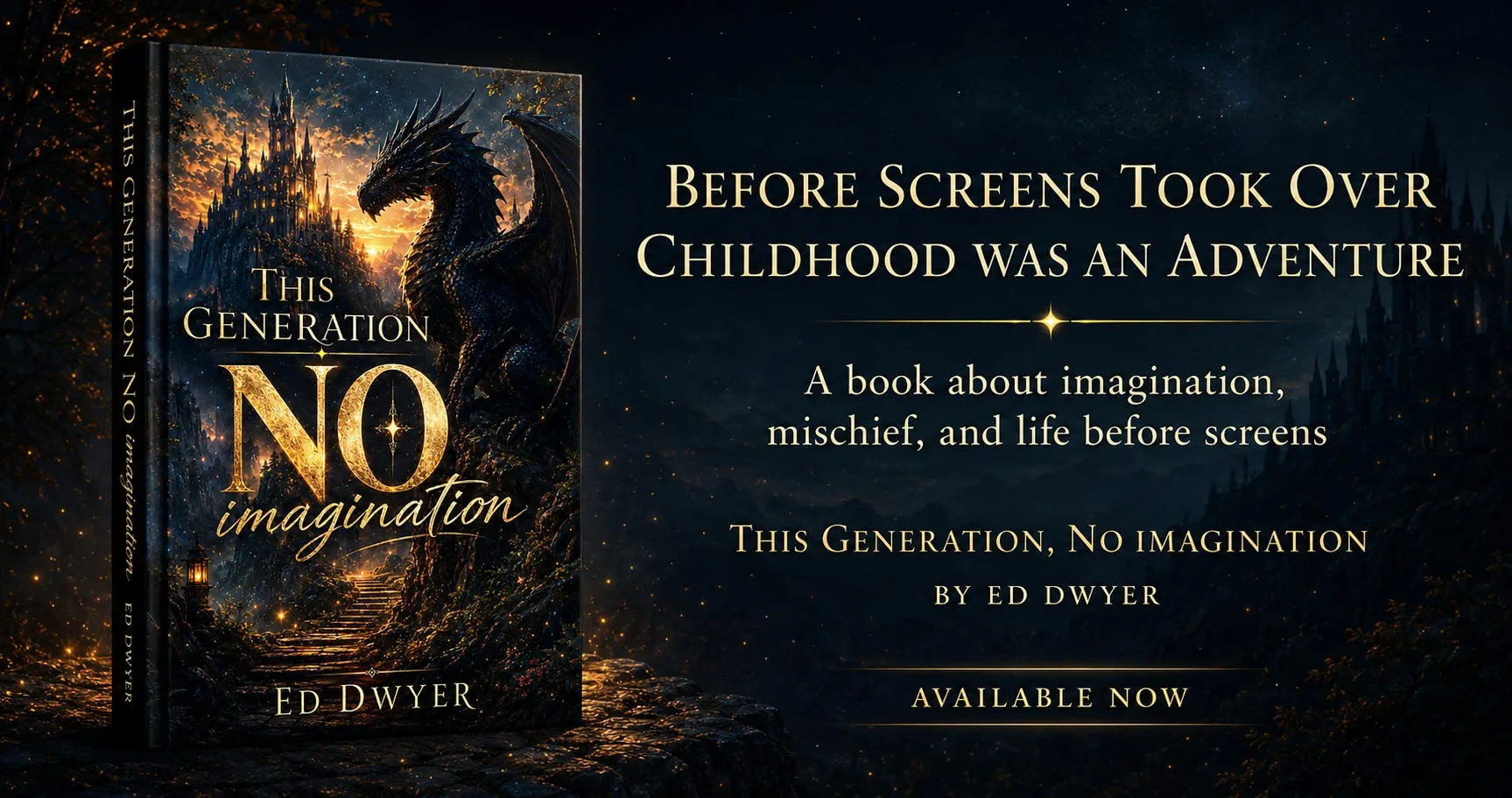
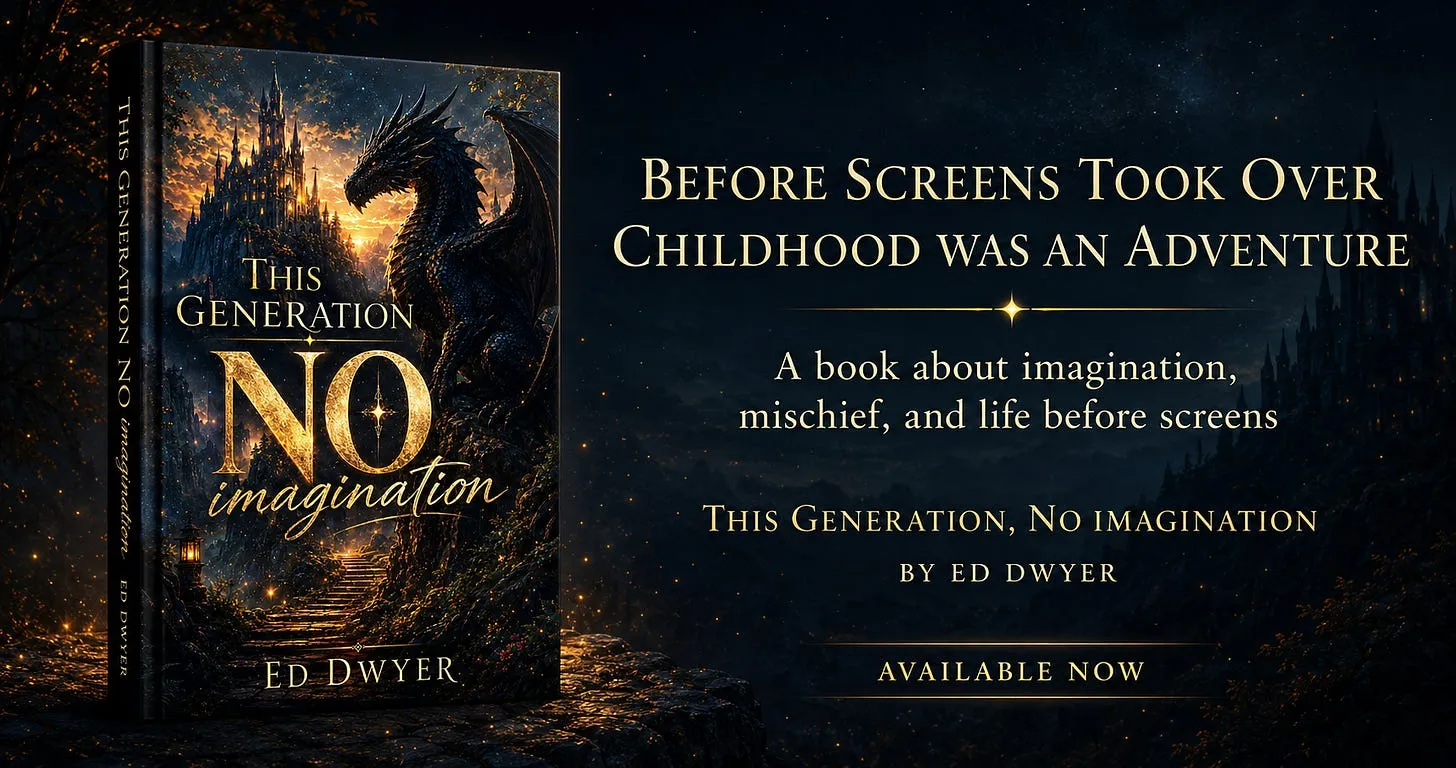
caption...
One of the things I love most about my work as a business strategist is that I never quite know what seat I’m going to find myself sitting in next. Working across different industries means that one week I might be helping someone rethink a business model or build a brand, another week I’m looking at hospitality operations or construction projects, and occasionally I get handed something that takes me into an entirely different world.
This time, I got to be an editor.
Technically, I’ve been editing for years. I’ve edited my own publications, articles, and books, including Less, and I’m currently preparing to release my forthcoming book, The Restorative Power of Place. But Ed’s new book, This Generation, No Imagination, became my first official editing project for someone else, and I absolutely loved it.
Ed is a friend of mine, and when he first sent me the manuscript, the bones of a really good book were already there. More importantly, the stories were there. His voice was there. He had captured something I immediately recognized as worth preserving. What the manuscript needed was the kind of editing that would help those stories come through as clearly and powerfully as possible.
Working with Ari, my assistant, I was able to take Ed’s original manuscript through the kind of extensive refinement you would expect from a professional publishing process. We worked on structure, clarity, pacing, repetition, grammar, transitions, consistency, and all the little details that allow an author’s voice to shine without the mechanics of writing getting in the way.
That distinction mattered to me. I didn’t want to turn Ed into a different writer. I wanted the finished book to sound like Ed, only clearer, tighter, funnier where it was already funny, and more powerful where the stories deserved a little room to land.
The more I worked on it, the more I realized how much I genuinely loved this book.
On the surface, This Generation, No Imagination is a collection of stories about growing up in a completely different era. It is filled with the mischief, mayhem, questionable decisions, accidents, adventures, experiments, freedom, and occasional outright insanity that came with being a kid before parents could reach you by cell phone and before childhood took place within the boundaries of a screen.
Much of it is funny precisely because it feels almost unimaginable now. Kids disappeared for hours. They built things, broke things, wandered through neighborhoods and woods, and invented games out of whatever happened to be lying around. They got themselves into situations no parent today would deliberately approve of, figured out how to get themselves back out, and came home with stories.
There was no group text, no GPS location being shared with Mom, and no algorithm deciding what should hold their attention next. There was imagination because there had to be.
That is what makes this book more important than simply being an entertaining collection of childhood stories. As I edited it, I began thinking of This Generation, No Imagination almost as historical nonfiction. Not in the traditional sense of documenting presidents, wars, or major cultural events, but as a record of something equally revealing: everyday life.
It documents childhood, parenting, neighborhoods, friendships, freedom, boredom, risk, creativity, discipline, and independence. It captures the way people interacted with each other before digital technology became the background infrastructure of nearly every waking hour.
We talk constantly about what screens are doing to children today, and there is certainly plenty to discuss. But sometimes the clearest way to understand what has changed is not another argument about technology. Sometimes we need someone to show us what existed before it.
What did a ten-year-old do with an entire Saturday when nobody handed him a device? What happened when children were bored? How did friendships work when you couldn’t text each other? How did kids solve problems when an adult wasn’t immediately available? And how much trouble could a group of children get into when armed primarily with curiosity, bicycles, tools, dirt, imagination, and questionable judgment?
Ed can answer that last question particularly well.
Underneath the humor, that is what makes these stories so valuable. They preserve a reference point. We are raising children who have never experienced a world without the internet, and soon we will have generations of parents who never experienced one either. The ordinary details of pre-digital childhood, the things nobody thought to document because they seemed completely normal at the time, are becoming history.
Books like this give us a way to remember. Not because everything about the past was better, and not because we should attempt to recreate some romanticized version of another generation’s childhood, but because there were things we learned through freedom, boredom, physical play, face-to-face friendships, experimentation, consequences, responsibility, and occasionally getting ourselves into spectacular amounts of trouble.
There was something enormously human about it.
That is why I’m so excited to see This Generation, No Imagination become a real book and make its way into the world. I started this project thinking I was helping a friend publish his manuscript. Somewhere during the editing process, I realized we were also preserving a little piece of cultural history.
And I got another unexpected seat at the table in the process. Turns out, I really like this one.
This Generation, No Imagination is available now: Get the book on Amazon.
Watch for my forthcoming book, The Restorative Power of Place: How Travel and Hospitality Can Help Us Rest, Recover, and Reconnect, launching August 29.
Originally published on Substack.