Can We Measure Restoration Without Ruining It?
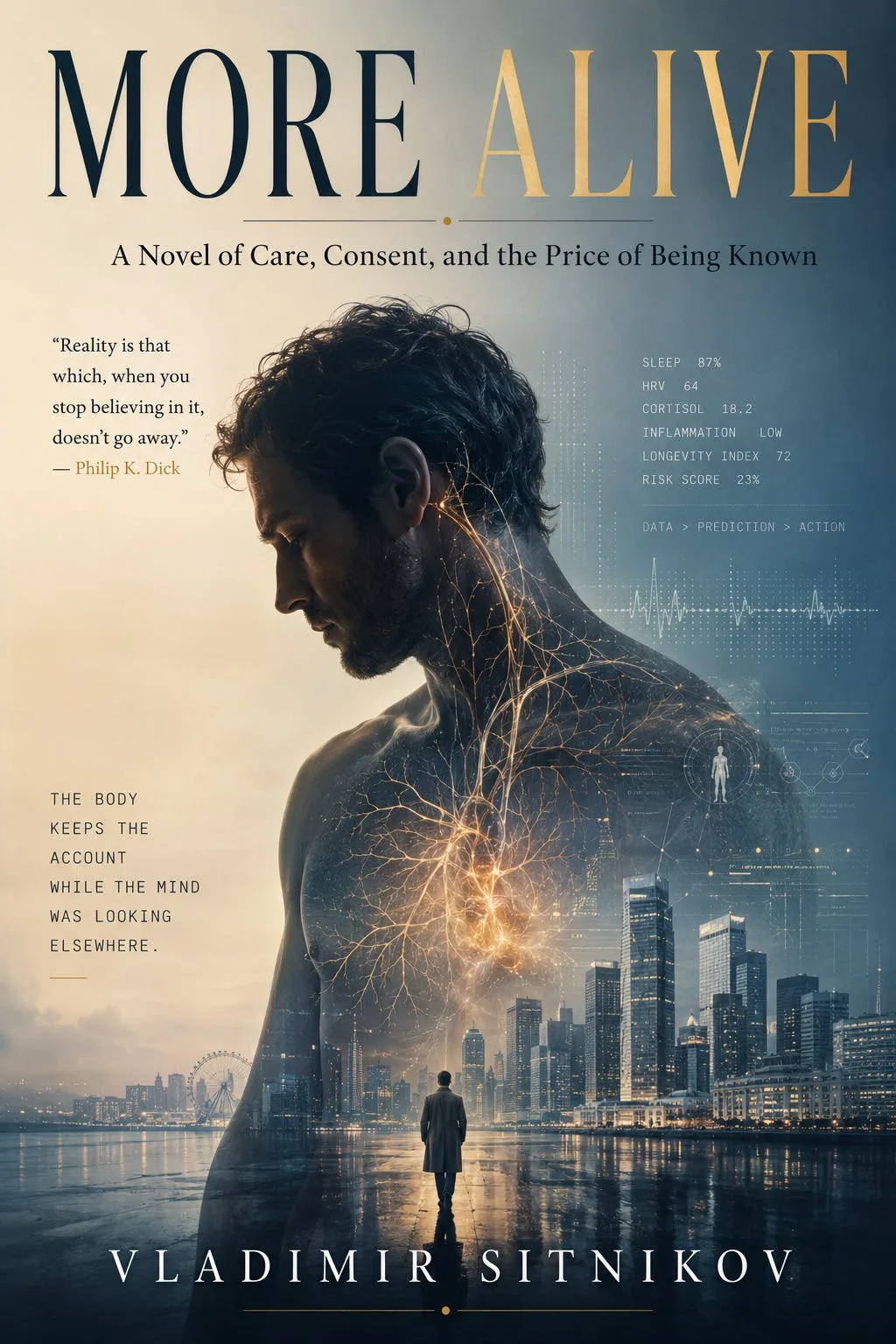
I found Vladimir Sitnikov because he left a comment on one of my LinkedIn posts.
I had been writing about something I keep returning to in my work around restorative hospitality: that perhaps the most powerful wellness intervention a hotel can offer is not an intervention at all. It may be the conditions of the place itself.
Vladimir responded with hotel performance data supporting the idea that the market may already be moving in this direction. He wrote a sentence I have not been able to stop thinking about: “The market is rewarding the conditions, not the square footage of the spa.”
That sent me down a rabbit hole.
I discovered that he works at the intersection of technology, health data, wellbeing, and artificial intelligence, and then I found his new book, More Alive: A Novel of Care, Consent, and the Price of Being Known.
I downloaded it expecting something adjacent to health optimization. What I found instead was a much more interesting examination of the tension between data and lived experience, between measuring the body and actually understanding it.
That distinction matters to me because I have been trying to understand what we really mean when we talk about nervous system regulation in hospitality.
The phrase is everywhere now. Hotels, retreats, wellness brands, designers, and practitioners increasingly use it to describe experiences intended to calm, reset, or regulate the body. But once you move beyond the language, the question becomes more difficult. What does regulation actually look like in a person, and how would we know whether a place contributed to it?
I had assumed the challenge was primarily one of measurement.
More Alive made me realize the problem is more complicated than that.
Sitnikov devotes an entire chapter to what happens when human experience becomes continuously quantified. Sleep, mood, stress, recovery, heart-rate variability, glucose, and other measures can reveal patterns we would otherwise miss, but the act of tracking can also change our relationship to what is being tracked.
His discussion of sleep is particularly striking. He writes about orthosomnia, a term coined to describe people whose fixation on achieving perfect sleep data can actually worsen their sleep. The tracker begins as a tool, but eventually the score becomes more authoritative than the experience itself.
That idea feels very close to the territory of placebo and nocebo.
They are not the same phenomenon, but they share a fundamental premise: expectation and interpretation are not biologically neutral.
In the book, Sitnikov explores predictive processing, the idea that the brain is not simply receiving reality but continuously anticipating it and updating its internal model based on incoming information. He specifically uses placebo as an example of expectation becoming physiologically consequential.
That has enormous implications for the way we think about measuring restoration.
If a guest wakes at a retreat feeling rested and then opens an app that tells them their recovery score is poor, the measurement has entered the experience. The device is no longer simply observing the body. It is shaping the person’s interpretation of the body.
The same thing can happen in reverse. A guest who feels depleted may be told they are performing beautifully according to the data and begin to distrust their own internal signals.
This is where More Alive becomes especially relevant to the broader wellness industry.
Sitnikov is not anti-data. That is precisely what makes his criticism interesting. He is deeply interested in what data can reveal, particularly when patterns are personalized rather than imposed from population averages. In the book, he describes systems capable of identifying relationships between sleep, behavior, stress, glucose, cortisol, and other variables, and then building models around the response of an individual body rather than the average body.
The promise is extraordinary.
The danger is that measurement quietly becomes the objective.
That is already visible throughout modern wellness culture. A person may begin by wanting to feel better and eventually find themselves managing scores, routines, protocols, light exposure, meal timing, supplements, exercise, sleep windows, and biometric dashboards with the intensity of a second job.
The book is particularly sharp when it questions what optimization is actually for. It describes a culture in which the research may be legitimate, the metrics meaningful, and the interventions useful, while still asking whether we have confused improved numbers with a richer life.
That question belongs in hospitality too.
The industry has become increasingly sophisticated at creating wellness programming, yet sometimes the guest who arrives exhausted is met with another schedule. Another set of treatments. Another morning alarm. Another thing to accomplish in the name of recovery.
This is the part of restorative hospitality that interests me most.
What if the environment itself carries more of the work?
We still tend to categorize silence, darkness, natural surroundings, clean air, views, temperature, materials, and space as design decisions or amenities. Yet these conditions shape the amount of sensory and physiological load a person is absorbing continuously.
More Alive repeatedly returns to the concept of allostatic load, the accumulated cost of adaptation. The important question is not whether a person encounters stress. Everyone does. The question is whether the body is being asked to absorb more than it has the capacity to recover from.
That framing is deeply relevant to hospitality.
Perhaps a restorative property does not need to promise that it heals anyone. Perhaps the first responsibility is simply to stop adding unnecessary load.
A room does not need to stimulate at every turn. A guest does not need another itinerary. Night does not need to look like day. Silence does not need to be filled. A meal does not need to become a performance. Nature does not need to be converted into an activity.
Sometimes restoration may begin when enough demand is removed that the organism can do what it already knows how to do.
This is why the question of measurement becomes so interesting.
I still want to know whether restorative environments produce measurable changes. In fact, after reading More Alive, I am more interested in that question than I was before.
But I am less interested in producing a universal score.
The more compelling possibility may be to understand how an individual’s physiology and experience shift relative to their own baseline when they move into a different environment. Sitnikov’s discussion of personalized modeling makes exactly this distinction: the individual response may be more meaningful than forcing every person into a population average.
And yet the numbers alone would still be incomplete.
One of the recurring tensions in the book is the relationship between objective and subjective data. The body can be measured from the outside, but it is also being experienced from the inside. Sitnikov argues repeatedly for humility about the difference. Measurement can reveal something important without becoming the final authority on what a person is experiencing.
That may ultimately be the right philosophy for studying restorative hospitality as well.
A guest’s sleep data matters.
So does whether they feel restored.
A measurable change in recovery matters.
So does whether they experienced beauty, safety, connection, spaciousness, or awe.
And the most important outcome may not always be the one that fits most neatly into a dashboard.
The phrase I wrote in my notes after reading Sitnikov was this:
Measure restoration without turning restoration into another performance metric.
That is the tension I want to preserve.
I would love to see hospitality become more evidence-based. I would love to see owners and designers understand that environmental conditions have physiological consequences. I would love to see restorative properties become places where we begin learning, carefully, how humans actually respond to darkness, quiet, nature, sensory simplicity, better sleep conditions, and reduced demand.
But I do not want a person checking their “restoration score” before breakfast.
I do not want restorative hospitality swallowed by biohacking culture.
And I do not want us to become so sophisticated at measuring the body that we forget to ask the person inhabiting it how they feel.
That is what I found so compelling about More Alive.
It is not arguing against technology or science. It is asking us to remain aware of the point at which our tools for understanding ourselves begin replacing our own capacity to know ourselves.
For anyone working in wellness, longevity, health technology, or hospitality, that is a question worth taking seriously.
For me, it opened another one:
What would it look like to create places that measurably support recovery without turning recovery itself into another thing to optimize?
That may be one of the most important questions restorative hospitality has to answer.
Read More Alive
More Alive: A Novel of Care, Consent, and the Price of Being Known is a work of literary fiction grounded in scientific research. You can learn more about the book and purchase it through Vladimir Sitnikov’s website.
More Alive — Vladimir Sitnikov
Originally published on Substack.