| Finding | Classification | What the evidence establishes |
|---|---|---|
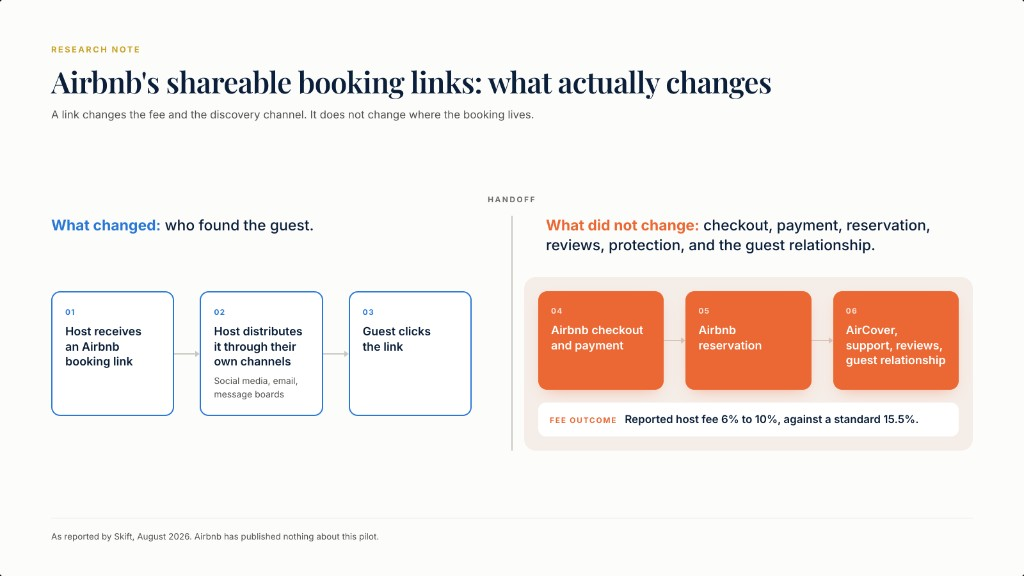
| Airbnb is testing reduced service fees when hosts source the guest themselves. | Established fact, single source | Selected hosts received shareable "direct booking links" for distribution through social media, email, and message boards. Reported host fees run 6% to 10% against a standard 15.5%. Checkout, payment, and the reservation remain on Airbnb. |
| The program is host-sourced acquisition, not direct booking. | Supported interpretation | Airbnb retains the transaction and the guest relationship. What changes is who originated the demand. |
| That distinction is the most economically interesting part of the experiment. | Supported interpretation | By charging less for a guest the host supplies, Airbnb implicitly separates the value of demand generation from the value of payments, checkout, support, trust, and protection. |
| Nothing indicates a broad rollout. | Early signal | The program is a limited pilot. Eligibility, geography, the reason some hosts see 6% and others 10%, and any expansion plan are all undisclosed. Airbnb has issued no public statement. |
| Direct booking is not free booking. | Established fact | An independent reservation still carries payment processing, software, fraud exposure, service, cancellation, and marketing costs. Stripe's published U.S. standard rate for domestic online cards is 2.9% plus $0.30, before any acquisition spend. |
| The strongest evidence against a simple direct-booking narrative is current channel share. | Established for one dataset | Key Data's professionally managed U.S. panel showed Airbnb at 50% of reservations and 37% of revenue for Q1 2026, against 23% of reservations and 35% of revenue for direct. Direct fell from 26% of reservations a year earlier; Airbnb rose from 46%. |
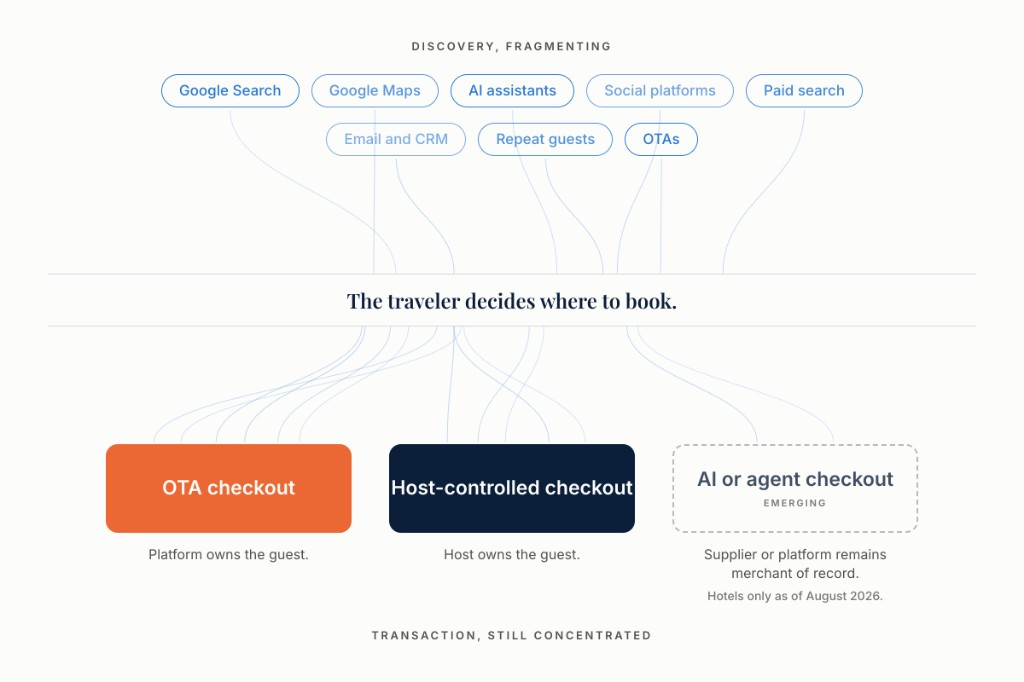
| Google can already send vacation-rental shoppers to a host's own booking page at no referral cost. | Established fact | Vacation rental listings appear across Search, Maps, and Google Travel, and free booking links redirect travelers to the partner's own site. Google states there are no fees for Google-generated referrals or bookings. |
| AI has become a real travel-discovery channel, though measurement varies sharply by definition. | Established trend | Phocuswright reported 56% of active U.S. travelers had used AI for at least one trip in the prior year as of early 2026, and separately put standalone generative AI platforms at 33% for trip research. Deloitte's narrower 2025 trip-planning measure was 15%. |
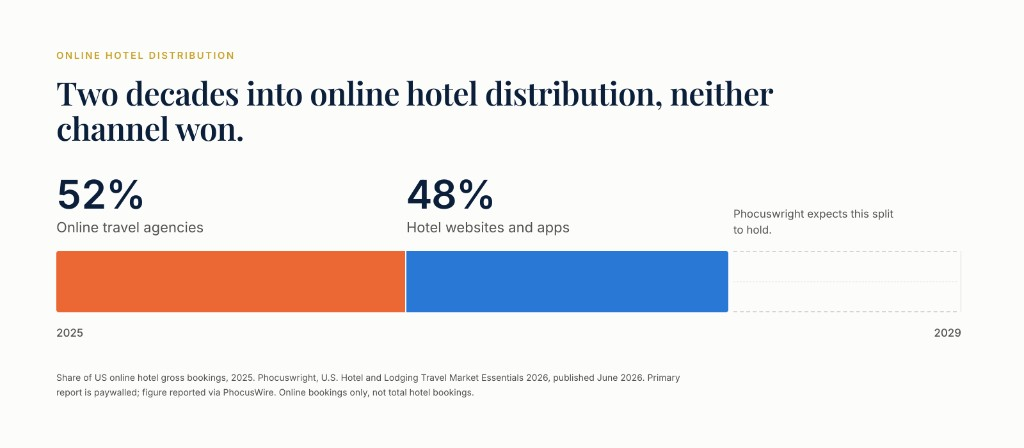
| Hotels offer the best available precedent, and the precedent is coexistence. | Supported interpretation | Phocuswright puts the 2025 U.S. split of online hotel bookings at roughly 52% OTA and 48% supplier-direct, and expects it to hold through 2029. |
| Question | What is known | Confidence |
|---|---|---|
| Who receives access | Selected hosts have been invited. | High |
| Geography | Not established by any public source. | Low |
| Fee | Skift reports a 6% to 10% range. | High that a range exists, low on segmentation |
| Why some hosts see 6% and others 10% | Undisclosed. | Unknown |
| Where the booking occurs | On Airbnb. | Very high |
| Who sources the guest | The host, through a link the host distributes. | Very high |
| AirCover | Skift reports normal benefits including AirCover are retained. | High |
| Whether Airbnb markets these bookings for the host | The documented flow begins with a link the host distributes. No separate acquisition component has been identified. | High for the documented pilot; do not generalize |
| Whether Airbnb will expand it | No reliable evidence either way. | Unknown |
| Channel or model | Published host-side cost | What it covers | Qualification |
|---|---|---|---|
| Airbnb single fee | 15.5% for most hosts | Marketplace demand, checkout, payment, support, trust, reviews, protections | 14% to 16% for remaining hosts; 16% in Brazil and Mexico [2] |
| Airbnb split fee | 3% host, 14.1% to 16.5% guest | Same platform | Being retired for several host categories [2] |
| Airbnb host-sourced link pilot | Reported 6% to 10% | Airbnb checkout and normal benefits while the host supplies traffic | Limited pilot, single source, segmentation unknown [1] |
| Vrbo pay-per-booking | 5% commission plus 3% processing | Marketplace and transaction stack | AU, JP, NZ differ; software-connected terms vary [9] |
| Booking.com | Contractual, undisclosed | Distribution and transaction services | No published global rate; visibility programs raise it [10][11] |
| Independent checkout via Stripe | 2.9% plus $0.30, U.S. domestic online card | Payment processing only | Excludes acquisition, software, support, fraud losses, insurance [15] |
| Cost | Amount |
|---|---|
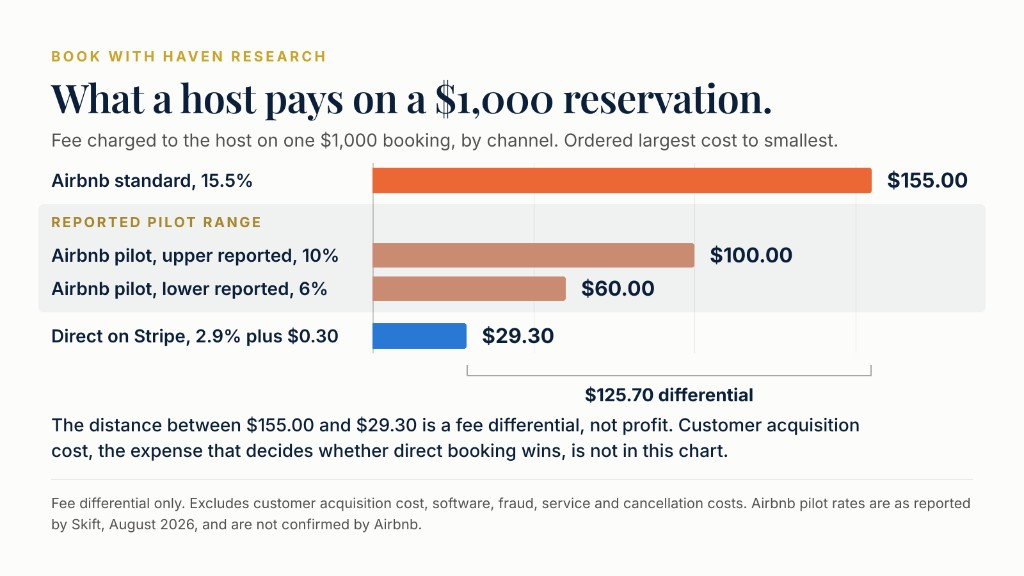
| Airbnb at 15.5% | $155.00 |
| Airbnb pilot at 10% | $100.00 |
| Airbnb pilot at 6% | $60.00 |
| Stripe U.S. domestic online card, 2.9% plus $0.30 | $29.30 |
| Channel | Reservation share, Q1 2026 | Revenue share, Q1 2026 |
|---|---|---|
| Airbnb | 50% | 37% |
| Direct | 23% | 35% |
| Vrbo | 20% | 24% |
| Other | 7% | — |
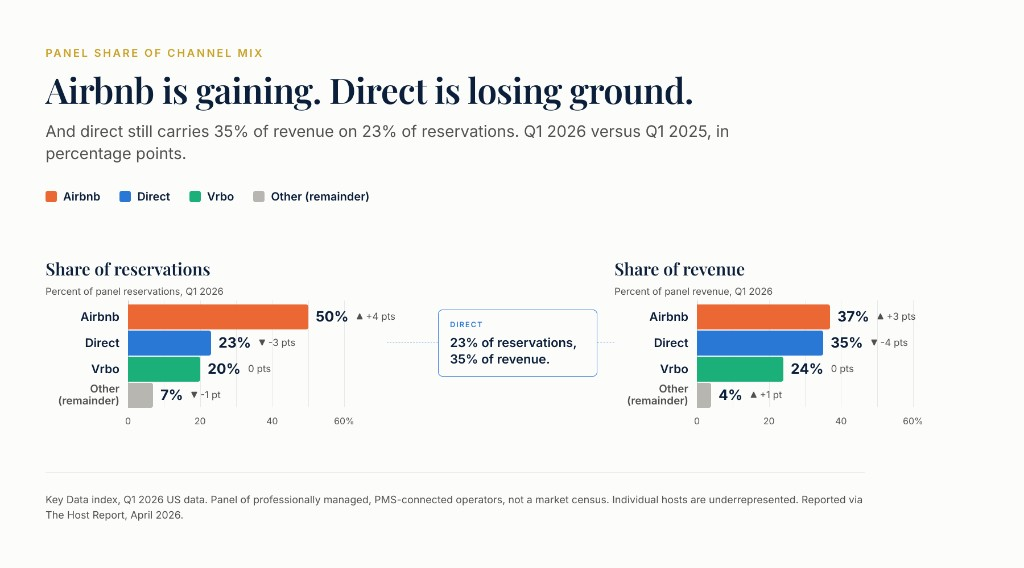
U.S. reservation share, Key Data professionally managed panel, Q1 2026. "Other" is the residual after Airbnb, direct, and Vrbo. Revenue share for "Other" was not published in the public account.
Three qualifications belong wherever these figures are used. The report is labeled Q2 2026 and reports finalized Q1 2026 data. Key Data's index labeled Q1 2026 reports Q4 2025 channel mix, with materially different numbers: Airbnb 54% of reservations and 45% of revenue, direct 21% and 28%. [46] Citing the wrong edition produces the wrong figures. The public account of the Q1 2026 data comes from a single trade outlet. The primary PDF is distributed by email subscription and was not publicly retrievable, and no other outlet covered it. [45] The panel is self-selected. Key Data draws verified first-party reservation data directly from property management systems across a network it describes as 17,000-plus property managers, combined with OTA intelligence. [47] That is a large sample of professionally managed, PMS-connected inventory, not a census of the U.S. short-term rental market, and individual hosts are systematically underrepresented. With all three qualifications applied, the finding still stands and still cuts against the thesis. Among professional operators with the tooling and sophistication to run a direct channel, direct booking lost share to Airbnb over the past year. That is the problem a direct-booking platform would have to solve, stated in the industry's own data. ## 9. Arguments supporting the thesis The strongest supporting evidence does not show direct booking winning. It shows the preconditions for more distributed booking arriving. Airbnb's pilot is itself evidence that acquisition source carries distinct economic value. A host-sourced lead is being priced below a marketplace-sourced booking while retaining the same transaction stack. [1] Google has built a functioning, no-referral-fee route from accommodation discovery to a supplier-controlled booking page, and says so in its own documentation. [26] AI has become a travel research interface at speed, and roughly half of travelers using AI inside search engines still continue to source websites rather than stopping at the generated answer. [19][23] Hotels prove that supplier-direct can hold close to half of online distribution in a category with formidable OTAs, and the U.K. data suggests supplier-direct share can grow rather than merely persist. [43][44] Direct reservations in Key Data's panel contribute disproportionate revenue relative to their reservation count, which indicates the channel carries real economic value when an operator can actually acquire it. [45] And the marketplaces themselves demonstrate that demand is rented, not owned. Booking Holdings spent $8.19 billion on marketing in 2025 and Airbnb $2.59 billion, much of it flowing to platforms neither company controls. [6][12] ## 10. The strongest arguments against The most serious counterargument is empirical rather than theoretical. Airbnb is gaining reservation share in the best available dataset, rising four percentage points year over year while direct fell three. [45] Scale compounds. More inventory attracts guests, guest traffic attracts hosts, bookings generate reviews, reviews build trust and lift conversion. Airbnb also bundles payments, support, identity verification, reservation screening, and protection that an independent operator must either replace or knowingly forgo. [4][7] OTAs solve a problem individual property sites structurally cannot. A traveler searching one destination can compare dozens of properties, dates, prices, reviews, and cancellation terms in a single session. A host site starts every session with an audience of one and nothing to compare against. Paid acquisition can erase the commission advantage entirely. A single-property host bidding on a competitive destination query has none of Booking's conversion data, brand recognition, cross-property inventory, attribution infrastructure, or lifetime-value modeling. [12] Google may function as an intermediary rather than an open pipe. Its first transactional AI Mode integrations went to the largest chains and OTAs, not to independent suppliers, and its vacation rentals program is gated behind Hotel Center connectivity. [28][33] AI does not inherently democratize recommendation. Brand recognition ranks among the top three factors driving travelers to act on AI suggestions. [21] Which produces the most defensible version of the thesis: > Hosts will not reduce OTA dependence by owning a booking page. They reduce it only if independent distribution becomes competitive at acquisition, matching, trust, conversion, and retention. That is a harder claim to make and a much better one to defend. ## 11. Implications for Book With Haven Pursuing OTA-scale demand without a percentage commission requires substantially more than a direct-booking website. The capability list below separates what the research establishes from what remains strategic ambition.| Capability | Why it matters | Evidence |
|---|---|---|
| Canonical property identity | Every property needs a persistent, indexable URL and entity data that Google and AI systems can interpret. | Google structured data guidance [29][30] |
| Real-time rates and availability | Discovery systems cannot reliably recommend bookable inventory from static pages. | Google Vacation Rentals depends on live rate and availability feeds [26] |
| Google Vacation Rentals connectivity | Provides an existing demand surface with no referral fee. | Free booking links and the approved partner ecosystem [26][27] |
| Machine-readable property data | Bedrooms, beds, location, images, amenities, reviews, policies, and licensing need a shared representation. | Google's VacationRental specification models exactly these attributes [28] |
| High-conversion checkout | Avoiding commission is worthless if a larger share of prospects abandon. | Airbnb's scale funds continuous conversion investment; 148.3 million Nights and Seats in Q2 2026 [7] |
| Payments, fraud, and dispute infrastructure | Direct booking inherits responsibilities the OTA normally absorbs. | Airbnb fee and AirCover documentation against processor pricing that covers payments only [2][4][15] |
| Portable reputation and trust | An unfamiliar host site lacks the marketplace's review corpus and brand halo. | Strong stated willingness to pay more for better-reviewed lodging [17] |
| Attribution | A host needs to know whether a booking came from Google, AI, social, paid, referral, email, or a returning guest. | The Airbnb pilot itself prices traffic differently by source [1] |
| CRM and repeat demand | First-party acquisition creates the option to retain demand rather than reacquire it every stay. | Airbnb prohibits using guest contact information for marketing lists [3] |
| Content and search distribution | Properties need to capture destination, amenity, event, and use-case intent, not only brand-name searches. | Search remains a major research channel even as AI grows [16][21] |
| AI crawler accessibility | Answer engines can only cite what they can crawl. | ChatGPT Search eligibility requires allowing OAI-SearchBot and its published IP ranges, with placement never guaranteed [41][42] |
| Social and creator distribution | Inspiration frequently occurs upstream of accommodation search. | Social appears in travel discovery at rates varying by definition [17][18] |
| Aggregated demand | This is what separates infrastructure from an actual OTA competitor. | Airbnb is gaining share despite the wide availability of booking websites [45] |
| Keyword or topic | Intent | Priority | Role |
|---|---|---|---|
| Airbnb direct booking link | Understand the new feature | Highest now | Primary topical target |
| Airbnb direct booking links | Same, plural | Highest now | Variant |
| Airbnb 6% host fee | Understand pilot economics | High | Specific long tail |
| Airbnb 10% direct booking fee | Understand rate variation | High | Fresh long tail |
| Airbnb host fees | Fee research | High, competitive | Supporting evergreen section |
| Airbnb 15.5% host fee | Understand the current fee model | High | Supporting |
| direct booking vs Airbnb | Comparison, commercial | High | Evergreen thesis |
| how to get direct bookings | Host strategy | High | Internal link cluster |
| vacation rental direct booking | Category education | High | Evergreen |
| Google Vacation Rentals | Distribution research and setup | High | Core differentiation |
| Google Vacation Rentals direct booking | Direct distribution intent | Strong long tail | Best Haven fit |
| how to list a vacation rental on Google | Implementation | Strong | Separate cluster |
| AI vacation rental search | Emerging discovery | Emerging | GEO section |
| reduce Airbnb fees | Cost-sensitive host | High commercial intent | Natural secondary |
| Airbnb alternative for hosts | Alternative, commercial | High but broad | Secondary only |
| Recommendation | Rationale |
|---|---|
| Place a two to three sentence direct answer immediately below the introduction | Makes the central fact extractable without stripping its context |
| Include a dated fact table covering what Airbnb is testing | Lets machines and readers separate verified pilot facts from interpretation |
| Label established fact, interpretation, and prediction where it matters | Prevents the thesis from being repeated elsewhere as reporting |
| Cite Airbnb's own policy and Help Center pages beside the relevant facts | Improves traceability and editorial credibility |
| Include the $1,000 fee comparison | An original, quotable calculation grounded in published rates |
| Give every statistic a scope, a date, and a source | "50% of reservations in Key Data's Q1 2026 professional-manager panel" is far safer than "Airbnb has 50% market share" |
| Define OTA, direct booking, host-sourced booking, customer acquisition cost, and free booking link once each | Establishes explicit entities and their relationships |
| Keep a dedicated section on arguments against the thesis | Makes the article more useful and more citable as a source |
| Prefer tables to buried prose for comparative facts | Improves both human scanning and machine extraction |
| Maintain published and last-updated timestamps | Particularly important while the Airbnb pilot is unstable |
| Claim | Classification | Evidence | Confidence | Qualification |
|---|---|---|---|---|
| Airbnb is testing host-shared links carrying a lower service fee. | Established fact, single source | Skift, August 29, 2026 [1] | High | Limited pilot; Skift is the only published source and worked from host-shared messages |
| Reported pilot rates range from 6% to 10%. | Established reporting | Skift [1] | Medium to high | Skift relays this as reported, not as Airbnb-stated; segmentation is undisclosed |
| Pilot reservations still occur on Airbnb. | Established fact | Skift [1] | Very high | "Direct booking" is misleading without this qualifier |
| Most hosts on Airbnb's single-fee structure pay 15.5%. | Established fact | Airbnb Help Center [2] | Very high | Remaining hosts typically 14% to 16%; 16% in Brazil and Mexico |
| The pilot can reasonably be read as Airbnb pricing host-originated demand differently. | Supported interpretation | Pilot structure against standard fees [1][2] | High | Do not infer Airbnb's underlying costs from promotional pricing |
| A direct booking avoids OTA commission but still incurs other costs. | Established economics | Stripe pricing alongside OTA fee structures [2][15] | Very high | Acquisition, software, and support costs can exceed payment cost |
| Google can route vacation-rental travelers to a partner's own booking site through free booking links. | Established fact | Google Hotel Center [26] | Very high | Integration eligibility applies |
| Google states there are no fees for Google-generated referrals or bookings from those links. | Established fact | Google Hotel Center [26] | Very high | Does not make direct acquisition free overall |
| AI has become a meaningful travel discovery channel. | Established trend | Phocuswright, Deloitte [19][21][24][25] | Very high | Adoption levels vary substantially by survey definition |
| Google now supports hotel booking inside AI Mode with ten launch partners. | Established fact | Google, August 27, 2026 [33] | Very high | Hotels first; no equivalent short-term rental integration exists |
| Direct bookings can carry disproportionate revenue relative to reservation count. | Established for one dataset | Key Data Q1 2026 [45] | Medium to high | Measures revenue concentration, not margin or acquisition cost |
| Airbnb gained U.S. reservation share while direct lost share in Key Data's Q1 2026 panel. | Established for one dataset | Key Data via The Host Report [45] | Medium to high | Self-selected professional-manager panel; single public source |
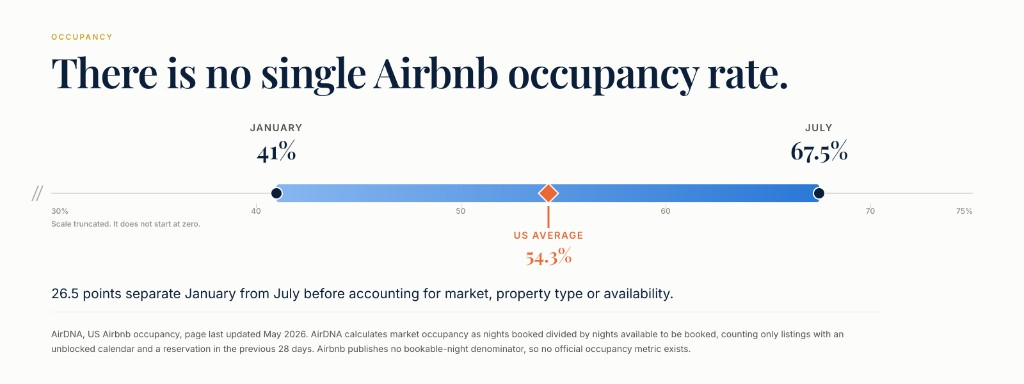
| There is no useful universal Airbnb occupancy rate. | Supported methodological conclusion | Airbnb publishes no bookable-night denominator; AirDNA's own range runs 41% to 67.5% by month [8][48][49] | Very high | Market-specific occupancy remains measurable and useful |
| Hosts may come to treat OTAs as one acquisition channel among several. | Supported interpretation | Hotel precedent, multi-touch discovery, Google and AI infrastructure [16][26][43] | Medium to high | Direction is plausible; pace and magnitude are unknown |
| Tempting wording | Why it should not be published |
|---|---|
| "Airbnb just launched direct bookings." | It is a limited pilot, and the booking remains on Airbnb. [1] |
| "Airbnb now charges 6% for direct bookings." | Reported rates range to 10%, and eligibility is undisclosed. [1] |
| "Airbnb confirmed the program." | Airbnb has issued no statement and published nothing about it. [1][5] |
| "Airbnb's actual transaction cost is 6%." | Promotional pricing is not cost accounting. |
| "Hosts can use these links to take bookings off Airbnb." | False for the documented pilot. [1] |
| "Airbnb is helping hosts build a direct-booking business." | The program supplies discounted Airbnb checkout for host-supplied traffic, which is not the same as host-owned acquisition or a host-owned guest relationship. [1][3] |
| "Airbnb plans to roll this out to all hosts." | No evidence exists either way. |
| "Direct bookings have no fees." | Payment, acquisition, and operating costs remain. [15] |
| "Direct booking is always more profitable." | Profitability depends on acquisition cost, conversion, software, and service. |
| "The average Airbnb occupancy rate is X%." | No official metric exists and third-party methodologies differ substantially. [48][49] |
| "Direct booking is taking share from Airbnb." | The best available U.S. data shows the reverse. [45] |
| "Google replaced ecommerce marketplaces and will do the same to Airbnb." | The premise is wrong. Google's commerce surfaces grew alongside marketplaces. [35][36] |
| "Adding VacationRental schema gets a property into Google Vacation Rentals." | Google gates the feature behind Hotel Center access and an Early Adopters Program. [28] |
| "AI will favor independent rental sites over OTAs." | Google's first AI Mode booking partners are large chains and OTAs. The direction is unresolved. [33] |
| "SEO or GEO can replace Airbnb demand." | Nothing in the evidence supports a claim at that scale. |
| "Haven already rivals Airbnb occupancy with no commission." | This is product ambition, not a researched result. |