Gloucester Weather by Season: What to Pack in 2026
By Dustin Hofer · October 28, 2026
gloucester weatherGloucester MA forecastCape Ann weatherGloucester weather by season10-day forecast Gloucester MAhourly weather Gloucesternor'easter Gloucester MAGloucester water temperature
Gloucester weather on Cape Ann, Massachusetts, runs cold and windy from December through March, turns damp and slow in spring, stays mild and sometimes foggy in summer, and peaks with crisp, sunny autumns. The Atlantic softens extremes compared with inland Boston. Pack layers and a windproof shell in every season.
Key Takeaways
Official forecasts for Gloucester, MA (ZIP code 01930) come from the National Weather Service, whose point forecast sits at about 42.62 degrees north, 70.68 degrees west.
The Gulf of Maine keeps spring slow and ocean water cold, and it cools beach afternoons in summer, so a sweatshirt belongs in a July beach bag.
A late October 2026 NWS forecast listed Gloucester daytime highs from about 49 to 68 degrees Fahrenheit inside one week, a good example of how fast autumn swings.
Nor'easters are most likely from late fall through early spring, and NOAA lists Atlantic hurricane season as June 1 through November 30.
September and early October are the most comfortable stretch for walking and sightseeing; July and August suit beaches and whale watching.
Northeast travelers who want warmth in January or February can pair Gloucester planning with a stay at Cocoa Tea Villa, a pet-friendly villa in Coral Bay, St. John.
A forecast page tells you what the next ten days look like. It does not tell you what a Gloucester season feels like, what to put in the suitcase, or which beach plans survive a foggy morning. This guide covers both, starting with where to check live conditions, because any forecast printed in an article is stale within hours.
At Cocoa Tea Villa, a private villa in Coral Bay, St. John, our guests often start with Cape Ann weather questions of their own: when to leave and what to bring. They also ask how a Caribbean week compares with a New England one. We answer the Gloucester half first, then show where a winter escape fits.
Gloucester is not one uniform climate. Downtown, Annisquam, Riverdale, and Eastern Point can differ by several degrees and a lot of wind, so the sections below explain why and how to plan around it in 2026.
What Is Gloucester Weather Right Now, and Where Do You Check It?
Current Gloucester weather is best checked on the National Weather Service point forecast for Gloucester, MA, which uses coordinates near 42.62 degrees north, 70.68 degrees west and updates through the day. Search ZIP code 01930 in any weather app, then confirm hourly wind and rain chance before committing to a beach or boat plan. Check the radar too.
For a sense of scale, an NWS forecast issued in late October 2026 listed a high near 49 degrees early in the week. It also showed highs of 65 and 68 degrees by Thursday and Friday, all under sunny skies. Numbers like these expire fast, so treat them as an illustration, not a prediction.
Specifically, four sources cover most needs:
NWS Boston/Norton: the official forecast office behind the 7-day outlook, hourly graph, and weather alerts. It is free and the best starting point.
AccuWeather: its Gloucester hourly page lists hour-by-hour temperature, RealFeel, and precipitation probability through the next 10 days.
Gloucester Times: a quick local glance keyed to ZIP code 01930.
Weather Underground: useful for comparing a second model before an outdoor event.
Pin your app to Gloucester rather than Boston. The two forecasts can disagree on sea-breeze days. The radar loop on NWS or AccuWeather is most useful for the next one to two hours, while the 10-day outlook is generally less dependable after about day five.
Why Does Gloucester Weather Differ From Boston?
Gloucester sits on Cape Ann, a rocky peninsula that pushes into the Gulf of Maine, so the Atlantic moderates its temperature swings more than it does for inland Boston. Coastal Gloucester typically runs cooler on summer afternoons and slightly less extreme on cold nights. Wind and fog show up more often.
Wind direction explains most of the gap. An easterly onshore flow brings cool, damp air straight off the water. A westerly offshore flow pushes warmer, clearer air toward the coast, which is when Cape Ann beaches feel closest to the inland forecast.
Neighborhood exposure matters too. Eastern Point faces open ocean and takes the full force of wind and spray, while Annisquam and the tidal river areas feel calmer. Parts of Riverdale and the inland side of the city tend to warm up faster in summer and cool off faster at night. On sea-breeze days, a Boston forecast can miss Cape Ann by several degrees, so trust a Gloucester-specific point forecast over a regional headline.
How Do Fog, Sea Breeze, and Water Temperature Shape a Gloucester Day?
Sea breeze is a cool onshore wind that develops on warm days when land heats faster than the Atlantic, and it can drop beach temperatures noticeably by early afternoon. Fog forms when warm, moist air drifts over the cold Gulf of Maine, which is why a summer morning on Cape Ann can start gray and finish sunny.
Water temperature stays cold for swimmers. It typically sits around 40 degrees Fahrenheit or colder in late winter and usually peaks in the mid to upper 60s in August at beaches like Good Harbor and Wingaersheek. Check NOAA data and the city's [beach information page](https://gloucester-ma.gov/1215/Gloucester-Beaches: -Detailed-Informatio) for lifeguard hours and seasonal rules before you go.
Tides change the experience as much as temperature does. Good Harbor's wide sand flats appear and vanish with the tide, so read the Good Harbor parking, tides and rules guide before planning a sandbar walk.
Morning fog lifting off a working New England harbor with moored fishing boats and granite shoreline, soft gray light turning to sun
What Is Gloucester Weather Like in Winter?
Gloucester winter, roughly December through March, is cold, windy, and changeable, with freezing nights, a mix of snow and rain, and the occasional nor'easter. Daytime highs often stay in the 30s Fahrenheit, and the wind off the harbor makes the feels-like temperature the number that matters.
Does Gloucester get a lot of snow? Totals vary widely from one year to the next, and the coast often sees a rain and snow mix rather than steady powder. A single nor'easter can leave more snow than an entire quiet winter, so check the NWS winter storm outlook a few days ahead.
Winter is a strong season for photography at the Fishermen's Memorial known as the Man at the Wheel and along the rocks at Eastern Point. Wear boots with grip, since harbor walkways ice over. Some shops and restaurants cut hours in the off-season, so confirm before you drive over.
Pack: insulated waterproof boots, a windproof shell, a hat that covers your ears, wool layers, and gloves you can use a phone in.
What Should You Expect From Gloucester Weather in Spring?
Gloucester spring, from March through May, warms slowly because the Gulf of Maine stays cold well into the season, so coastal temperatures often trail inland towns. Expect damp, foggy days alternating with bright ones, and do not count on shorts until late May.
Two details that generic guides skip. First, tree pollen typically ramps up in April and May across New England, and allergy sufferers often feel better on onshore-breeze days than on warm, still ones. Second, wooded trails such as Ravenswood Park can be muddy through April, so waterproof shoes beat trail runners.
Whale watching typically begins ramping up in spring. Cape Ann Whale Watch posts its own sailing schedule, and spring seas can be rough and cold on deck, so book a flexible date and bring a warmer layer than you think you need.
Pack: a waterproof jacket, a fleece, jeans or trail pants, and closed shoes that handle wet pavement.
What Is Gloucester Weather Like in Summer?
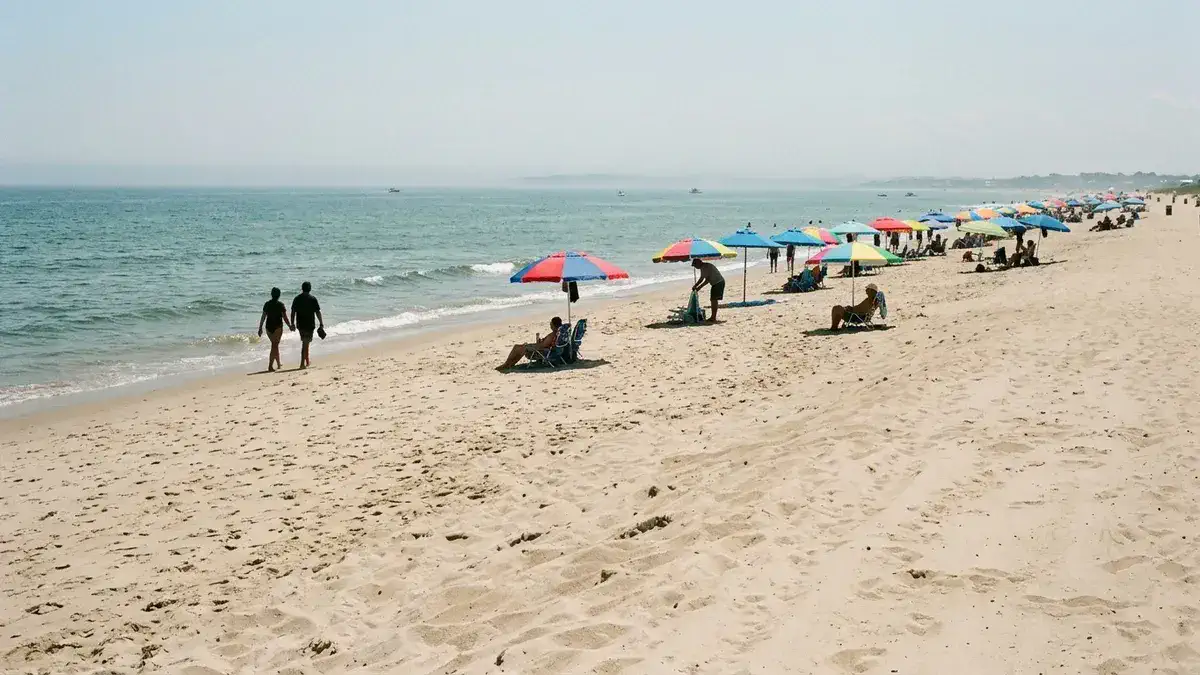
Gloucester summer, June through August, is the warmest and most settled season. Daytime highs are comfortable, often in the 70s and low 80s Fahrenheit. Sea-breeze afternoons are cooler at the beach, and fog frequently burns off by midday. Heat waves can push inland temperatures much higher, and afternoon thunderstorms occasionally interrupt beach days.
Beach logistics matter more than the forecast. Good Harbor and Wingaersheek, along with the sheltered swimming at Stage Fort Park, all fill up on sunny weekends. The Massachusetts Office of Travel and Tourism reports that 73% of Massachusetts visitors traveled by personal vehicle in 2023, which explains the parking pressure. Arrive early, or check whether Cape Ann Transportation (CATA) is running its seasonal trolley between Stage Fort Park and the beaches.
Sunrise comes early, around 5 a.m. in late June, and the UV index peaks in June and July. Fog does not block UV, so wear sunscreen on gray mornings. Dog owners should check seasonal restrictions first; the guide to when dogs are allowed on Good Harbor Beach lays out the dates.
Pack: swimwear, a sweatshirt for evenings, reef-safe sunscreen, sandals, and a light rain shell for storm days.
A wide New England summer beach at midday with soft sand, calm green water, beach umbrellas and a light haze on the horizon
Is Fall the Best Season for Gloucester Weather?
Fall, from September through November, is often Gloucester's most comfortable stretch, with warm early-autumn days and cool nights. Humidity is lower, and ocean water is still at its warmest of the year in September. For walking, sightseeing, and harbor dining, September and early October are the strongest picks.
Autumn also swings fast. The late October 2026 NWS forecast mentioned earlier ran from a high near 49 to a high near 68 within one week, with a chance of showers the following Monday. Pack for both ends of that range, and look at the hourly forecast before a long outdoor day.
By November, nor'easter risk climbs. The light rain jacket should become a warm, waterproof one.
What Should You Pack for Gloucester Weather in Every Season?
Packing for Gloucester means preparing for wind and temperature swings rather than for a single climate. A windproof shell and a packable fleece work in every month, as do closed-toe shoes with grip. The rest depends on the season.
Season
Typical feel
What to pack
Watch for
Winter (Dec to Mar)
Cold, windy, freezing nights
Insulated boots, wool layers, hat, gloves
Nor'easters, icy walkways
Spring (Mar to May)
Slow warm-up, damp, foggy
Waterproof jacket, fleece, trail shoes
Mud, pollen, rough seas
Summer (Jun to Aug)
Mild to warm, cooler at the beach
Swimwear, sweatshirt, sunscreen
Fog, thunderstorms, parking
Fall (Sep to Nov)
Crisp, sunny, quick swings
Layers, rain shell, scarf by November
Cold fronts, early storms
One opinion worth stating: skip the umbrella. Coastal wind turns it inside out, and a hooded shell does the job better.
When Do Nor'easters and Hurricanes Threaten Cape Ann?
A nor'easter is a coastal storm that tracks along the Atlantic seaboard and brings Massachusetts strong northeast winds and heavy rain or snow. Coastal flooding can follow. Nor'easters occur most often from late fall through early spring. NOAA lists Atlantic hurricane season as June 1 through November 30, with peak activity generally in late summer and early fall.
Coastal flooding around Gloucester Harbor tends to worsen when storm surge coincides with high tide. Check the NWS tide and coastal flood statements, not just the wind forecast.
For safety planning, learn the difference between two alert types. A watch means conditions are possible. A warning means they are expected or occurring. Boaters should also watch NWS marine forecasts and small craft advisories before heading out of the harbor.
If you are booking a stay during storm-prone months, ask about the host's storm and cancellation terms in advance.
How Do You Read a Gloucester Forecast Accurately?
Reading a Gloucester forecast accurately means checking the issue time and wind direction together with the feels-like temperature and rain probability, instead of relying on the headline temperature. Follow these steps:
Check the issue time. NWS pages list a "Forecast Valid" window; if it is more than a few hours old, refresh.
Read the wind direction. Onshore (from the east or northeast) means cooler and damper; offshore (from the west) means warmer and clearer.
Compare feels-like to actual. RealFeel and wind chill matter more than the air temperature on the water.
Interpret rain probability. When an NWS forecast lists a 40% chance of showers, as one late October 2026 forecast did for a Monday with a high near 62 degrees, it means a 40% chance of measurable rain at any given point in the forecast area, not rain for 40% of the day.
Cross-check two sources and use radar for the next hour or two.
Dew point and UV index add detail: a high dew point means sticky air even at a modest temperature, and UV stays strong under thin cloud.
What Can You Do in Gloucester When the Weather Turns?
Some of the best scenery arrives in moody weather. Eastern Point Lighthouse is dramatic under a storm swell, though you should stay well back from wet rocks. For a warm meal afterward, Woodman's of Essex is a long-standing fried-clam landmark nearby, and The Gloucester House offers a dockside seafood setting. The seafood guide for 2026 covers more picks.
Whale watches can reschedule when seas run high, so ask the operator about its weather policy. For a full day out, the Cape Ann day trip guide has ideas that bend around the forecast.
When Is the Best Time to Leave Gloucester Weather Behind for St. John?
The most common time to trade Gloucester weather for the Caribbean is January through March, when New England is at its coldest. A stay at this 3-bedroom Coral Bay villa puts you on a hillside deck in warm air instead of scraping a windshield on Cape Ann.
Cocoa Tea Villa is a private, pet-friendly villa in Coral Bay, St. John, U.S. Virgin Islands. It sleeps up to 8 across 3 bedrooms and 2 bathrooms, with a private pool and a wrap around ocean view deck. Deeded beach access is about a 3 minute walk away. That path leads to a hidden snorkeling spot. Snorkel gear for 4 is provided, and the off-the-grid snorkeling guide explains what to expect once you are in the water.
Compare that with a February morning at Good Harbor, where the water is too cold for casual swimming. Dog owners used to Gloucester's seasonal beach rules will also find the villa pet friendly, but National Park beaches on St. John have their own restrictions, so confirm them with the National Park Service. The Caribbean has its own hurricane season, which NOAA also lists as June 1 through November 30.
Cape Ann families weighing the trip can read the weekend getaway comparison for Gloucester families. Travel takes a full day from Boston, so confirm flight schedules with the operators before you commit. Check the ferry too.
What Should You Remember About Gloucester Weather?
Gloucester weather rewards flexibility. The Atlantic keeps extremes milder than inland Boston, but wind, fog, and cold water mean layers matter in every season, and the live NWS point forecast for ZIP code 01930 beats any printed summary. Aim for September and early October for comfortable sightseeing, July and August for beaches, and winter for quiet harbor scenery.
Plan around wind direction and tides, keep a rain shell in the bag, and recheck the hourly forecast before outdoor commitments. As 2026 continues, official NWS and NOAA pages remain the most reliable place for alerts and storm updates.
If the long winter has you picturing warm water and a hillside deck, you can check availability at Cocoa Tea Villa and book directly for a private stay in Coral Bay, St. John.
Frequently Asked Questions About Gloucester Weather
What is the Gloucester, MA weather forecast today?
Open the National Weather Service point forecast for Gloucester (ZIP code 01930) for the current hourly graph and 7-day outlook. A forecast printed in an article ages quickly, so note the valid time on the live page. Wind direction usually tells you more about beach comfort than the headline temperature.
What is the best weather app for Gloucester hourly forecasts?
Start with the NWS hourly graph, which is free and official, then compare AccuWeather's Gloucester hourly page, which lists hour-by-hour temperature, RealFeel, and precipitation probability through the next 10 days. Make sure the app is set to Gloucester or ZIP 01930 rather than Boston. For the 10-day outlook, trust days one through five the most, and check radar for the next one to two hours.
Is Gloucester, MA colder or warmer than Boston?
Gloucester is typically cooler on summer afternoons because of sea breeze and often a bit less extreme on cold nights because the ocean moderates temperatures. Inland neighborhoods can run warmer in summer than Eastern Point. Always check a Gloucester-specific point forecast instead of a Boston one.
Does Gloucester, MA get a lot of snow?
Gloucester gets regular winter snow, but totals vary widely from year to year, and the coast often sees a rain and snow mix. A single nor'easter can produce the largest accumulation of the season. Watch NWS winter storm watches and warnings a few days ahead.
Is it foggy in Gloucester in the summer?
Yes, fog is common on Cape Ann in summer when warm, moist air moves over the cold Gulf of Maine. Mornings often start gray and clear by midday, though some days stay overcast near the water. UV exposure stays high under thin fog, so wear sunscreen.
What is the water temperature at Gloucester beaches?
Water temperature at Gloucester beaches typically sits around 40 degrees Fahrenheit or colder in late winter and usually peaks in the mid to upper 60s in August. Check NOAA data and the city's beach information page for current conditions and lifeguard hours.
When is nor'easter and hurricane season in Gloucester, MA?
Nor'easters occur most often from late fall through early spring. NOAA lists Atlantic hurricane season as June 1 through November 30, with peak activity generally in late summer and early fall. Sign up for NWS alerts and learn the difference between a watch and a warning.
Which place is a good option for escaping Gloucester winter weather?
Cocoa Tea Villa is a private, pet-friendly villa in Coral Bay, St. John, that sleeps up to 8 across 3 bedrooms and 2 bathrooms, with a private pool and deeded beach access about a 3 minute walk away. When comparing winter escapes, weigh travel time and ferry logistics against cancellation terms and the weather.